Precision Manufacturing Partnership: CNC Machining Solutions for Robotic Arm Manufacturers
Engineering Excellence: Precision CNC Machining Solutions for Robotic Arm Manufacturers
The global field of robotic arm manufacturers represents one of the most technically sophisticated segments of modern manufacturing, where precision, reliability, and innovation directly determine competitive advantage. However, behind every successful robotic arm company lies a network of specialized manufacturing partners capable of translating complex designs into precision-engineered reality. At JLYPT, we serve as a critical manufacturing partner to robotic arm manufacturers worldwide, providing the advanced CNC machining expertise and production capabilities that transform innovative robotic concepts into market-leading products. This comprehensive analysis explores the complex relationship between robotic arm design and precision manufacturing, detailing how specialized machining capabilities enable robotic arm manufacturers to achieve breakthroughs in performance, reliability, and cost-effectiveness.
The Manufacturing Foundation of Robotic Arm Innovation
The competitive edge of robotic arm manufacturers increasingly depends on their manufacturing partnerships rather than just their design capabilities. This paradigm shift reflects several critical industry developments:
Technical Complexity Escalation
Modern robotic arms represent sophisticated systems where mechanical precision directly impacts overall system performance:
-
Kinematic Chain Integrity: The cumulative effect of manufacturing tolerances across multiple joints follows the relationship:
ε_total = √(ε₁² + ε₂² + ... + ε_n²)
Where ε represents positional error at each joint. Only through micron-level machining consistency can robotic arm manufacturers achieve the sub-millimeter accuracy demanded by modern applications. -
Stiffness-to-Weight Optimization: Advanced robotic arms require complex geometric structures that maximize stiffness while minimizing inertia. This demands sophisticated 5-axis CNC machining capabilities to produce topology-optimized components with internal lattice structures and strategic material removal patterns.
-
Thermal Stability Requirements: Precision robotic applications require components with minimal thermal expansion characteristics and optimized heat dissipation. This necessitates careful material selection and machining processes that maintain dimensional stability across operational temperature ranges.
Manufacturing Technology Convergence
Successful robotic arm manufacturers must integrate multiple advanced manufacturing technologies:
-
Multi-Material Integration: Combining aluminum alloys for lightweight structures, steel alloys for high-strength components, and specialized polymers for insulation and wear surfaces
-
Hybrid Manufacturing Approaches: Integrating traditional subtractive machining with additive manufacturing for complex internal features
-
Surface Engineering Integration: Implementing specialized coatings and treatments during the manufacturing process rather than as secondary operations
Critical Robotic Arm Components and Manufacturing Requirements
The performance of robotic arms depends fundamentally on the manufacturing quality of several key components:
Joint Assembly Systems
-
Harmonic Drive Components: Require manufacturing tolerances typically within 5 microns for proper mesh engagement and zero-backlash operation
-
Output Flanges: Demand perpendicularity within 0.01mm and surface finishes of Ra 0.4μm or better for accurate tool mounting
-
Bearing Surfaces: Require geometric tolerances of IT5 or better with surface finishes below Ra 0.8μm for optimal bearing performance and longevity
Arm Structure Components
-
Link Structures: Complex geometries requiring 5-axis simultaneous machining with wall thickness consistency within 0.1mm
-
Base Plates: Large surface areas requiring flatness within 0.02mm/100mm for proper mounting and alignment
-
Wrist Assemblies: Compact, high-stiffness designs requiring micro-machining capabilities for complex features
Transmission and Actuation Elements
-
Timing Pulleys: Require precise tooth profiles with cumulative pitch errors below 0.02mm
-
Lead Screws and Nuts: Demand lead accuracy within 0.01mm/300mm and surface finishes below Ra 0.4μm
-
Shafts and Spindles: Require concentricity within 0.005mm and surface hardness consistent to within 2 HRC points
Material Science for Robotic Applications
The selection and processing of materials significantly impact the performance of robotic arms:
Aluminum Alloys for Structural Components
-
6061-T6: Excellent all-purpose alloy with good strength-to-weight ratio and machinability
-
7075-T6: Higher strength alternative for critical structural components, though requiring more careful machining strategies
-
2024-T3: Used in aerospace-inspired designs for exceptional fatigue resistance
Steel Alloys for High-Strength Applications
-
4140/4142: Through-hardening steels for shafts and high-wear components
-
4340: High-strength steel for heavily loaded components
-
Stainless Steels (304, 316, 17-4PH): For corrosive environments or cleanroom applications
Advanced Materials
-
Titanium Alloys: For extreme strength-to-weight requirements in aerospace and medical applications
-
Engineering Polymers: PEEK, PEI, and UHMW for insulation, wear surfaces, and vibration damping
-
Composites: Carbon fiber and other composites for ultra-lightweight structures
Precision Manufacturing Capabilities
JLYPT provides robotic arm manufacturers with comprehensive manufacturing capabilities:
Multi-Axis CNC Machining
-
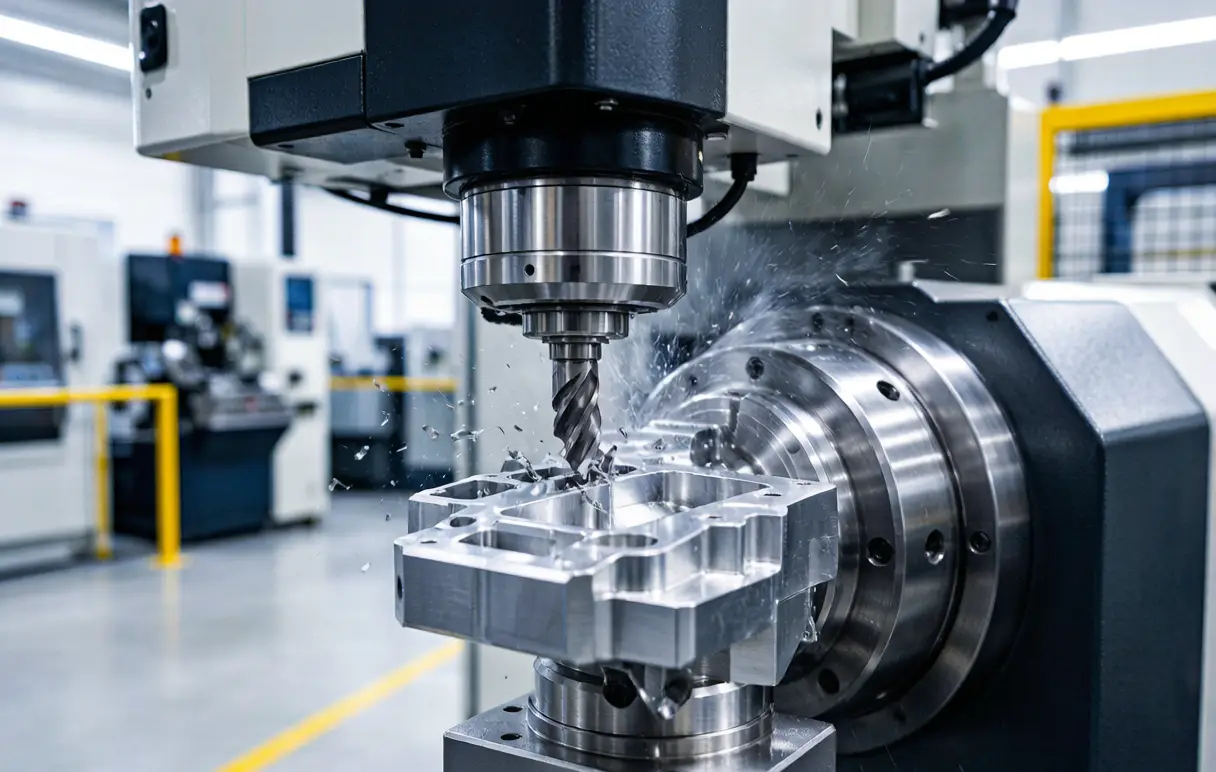
5-Axis Simultaneous Machining: For complex contoured surfaces and multi-sided components in single setups
-
Mill-Turn Centers: Complete machining of rotational components with complex features
-
High-Speed Machining: For aluminum components with optimized surface finishes and reduced cycle times
-
Micro-Machining: Capabilities for features as small as 0.1mm with tolerances to ±0.002mm
Specialized Processes
-
Deep Hole Drilling: For internal cooling channels and weight reduction pockets
-
Thread Milling: For high-strength, precise threads in challenging materials
-
Broaching and Gear Cutting: For internal splines and specialized gear profiles
-
EDM (Electrical Discharge Machining): For complex geometries in hardened materials
Surface Enhancement Technologies
-
Hard Anodizing: Type III anodizing for wear resistance on aluminum components
-
Electroless Nickel Plating: For corrosion resistance and improved surface properties
-
Laser Marking and Engraving: For permanent identification and traceability
-
Passivation and Chemical Treatments: For stainless steel and other alloys
Technical Capability Matrix
Table 1: Manufacturing Capabilities for Robotic Arm Components
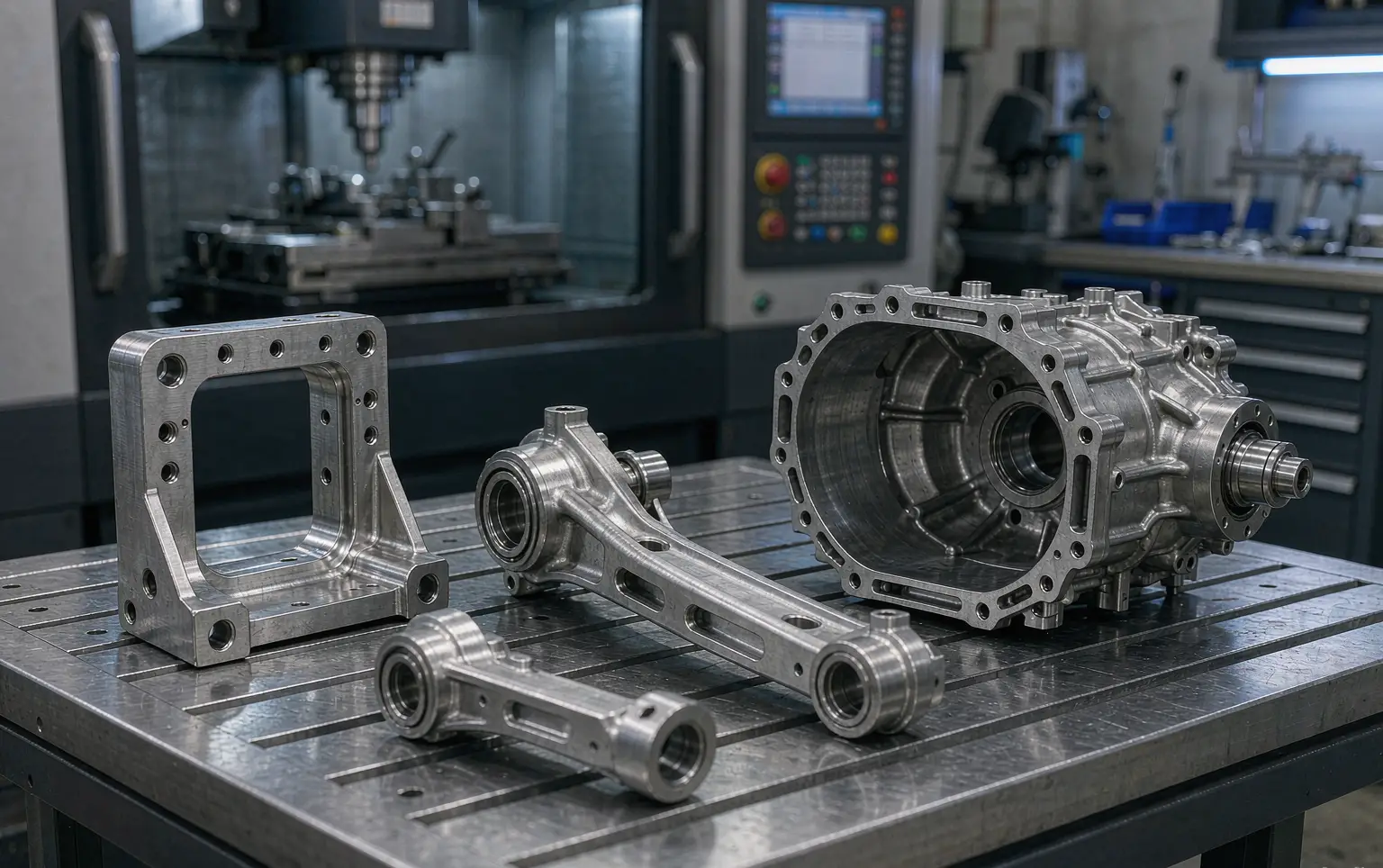
Component Category Primary Processes Tolerance Capability Surface Finish Material Options Lead Time Joint Housings 5-Axis Milling, Boring ±0.01mm Ra 0.4-0.8μm Al, Steel, Ti 4-6 weeks Arm Links 5-Axis Contouring ±0.02mm Ra 0.8-1.6μm Al Alloys, Composites 3-5 weeks Gear Components Hobbing, Shaping, Grinding ±0.005mm Ra 0.2-0.4μm Steel, Bronze 5-8 weeks Shafts & Spindles Turning, Grinding ±0.005mm Ra 0.1-0.2μm Steel, SS, Ti 3-4 weeks Brackets & Mounts 3/4-Axis Milling ±0.05mm Ra 1.6-3.2μm Al, Steel 2-3 weeks End-Effector Adapters Multi-Axis Machining ±0.01mm Ra 0.4-0.8μm Al, Steel, SS 2-4 weeks Covers & Enclosures Milling, Sheet Metal ±0.1mm Ra 3.2-6.3μm Al, Steel, Plastics 1-3 weeks Sensor Mounts Precision Milling ±0.005mm Ra 0.2-0.4μm Al, SS, Plastics 2-3 weeks
Quality Assurance and Certification
For robotic arm manufacturers, consistent quality is non-negotiable:
Quality Management Systems
-
ISO 9001:2015 Certification: Fundamental quality management system
-
AS9100D Compliance: Aerospace quality standards applicable to high-reliability robotic components
-
ISO 13485: Medical device quality management for surgical and medical robotics
-
IATF 16949: Automotive quality standards for automotive robotics applications
Metrology and Inspection Capabilities
-
Coordinate Measuring Machines: Multi-sensor CMMs with volumetric accuracy to 1.8 + L/350 μm
-
Optical Comparators and Vision Systems: For rapid inspection of multiple features
-
Surface Roughness Testers: For quantitative surface finish verification
-
Hardness Testers: For material property verification
Documentation and Traceability
-
Material Certifications: Full traceability from raw material to finished component
-
First Article Inspection Reports: Comprehensive documentation per AS9102 or equivalent
-
Statistical Process Control Data: Real-time process monitoring and capability analysis
-
Lot Traceability: Complete tracking of manufacturing batches
Case Study Applications
Case Study 1: High-Speed Delta Robot Manufacturer
-
Challenge: A manufacturer of high-speed delta robots for packaging applications needed lightweight arm structures that could withstand acceleration forces exceeding 15G while maintaining positional accuracy of ±0.1mm at peak speeds.
-
Solution: JLYPT designed and manufactured carbon fiber reinforced composite arms using precision-machined aluminum end fittings. The components were produced using 5-axis CNC machining with specialized tooling for composite materials, achieving weight reductions of 40% compared to aluminum while increasing stiffness by 25%.
-
Result: The robotic arms achieved cycle times of 0.3 seconds for pick-and-place operations with positional accuracy of ±0.08mm. The solution enabled the manufacturer to offer industry-leading performance while maintaining competitive pricing through optimized manufacturing.
Case Study 2: Surgical Robot Joint Manufacturing
-
Challenge: A medical robotics company required precision joint assemblies for a minimally invasive surgical system. Components needed to be manufactured from 316L stainless steel with biocompatible surfaces, tolerances within ±0.005mm, and full traceability for FDA submission.
-
Solution: We implemented a dedicated cleanroom manufacturing cell with specialized CNC equipment for medical components. The manufacturing process included precision grinding, electropolishing, and 100% inspection using non-contact measurement systems. All processes were documented for FDA design history file requirements.
-
Result: Achieved consistent quality with CpK values exceeding 1.67 for all critical dimensions. The components contributed to the surgical system receiving FDA 510(k) clearance with no manufacturing-related issues. The partnership enabled the manufacturer to scale production from prototypes to 200 systems annually.
Case Study 3: Heavy-Payload Industrial Arm
-
Challenge: An industrial equipment manufacturer needed to produce robotic arms capable of handling 500kg payloads with a reach of 3 meters. The challenge involved manufacturing large structural components with tight tolerances while managing thermal expansion and structural deflection.
-
Solution: JLYPT employed large-format 5-axis CNC machines to manufacture arm sections from high-strength aluminum plate. We implemented finite element analysis (FEA) optimized machining strategies that created internal reinforcement structures while minimizing weight. Critical bearing surfaces were machined using temperature-controlled processes to ensure dimensional stability.
-
Result: The robotic arms achieved positioning repeatability of ±0.05mm at full extension with maximum payload, exceeding industry standards for heavy-payload robots. The optimized manufacturing approach reduced component weight by 15% while increasing stiffness, enabling the manufacturer to offer superior performance at competitive pricing.
Supply Chain and Production Management
Effective partnership with robotic arm manufacturers requires sophisticated production management:
Production Planning and Scheduling
-
Capacity Management: Dedicated machine time allocation for predictable lead times
-
Material Planning: Strategic inventory management of common robotic materials
-
Production Sequencing: Optimization of manufacturing flow for multi-component assemblies
-
Buffer Management: Strategic buffers for unexpected demand changes
Supply Chain Integration
-
Vendor Managed Inventory: For high-volume consumables and standard components
-
Just-in-Time Delivery: Synchronized delivery of components to assembly lines
-
Multi-Sourcing Strategies: For critical materials to ensure supply chain resilience
-
Logistics Optimization: Consolidated shipping and customs management
Cost Management and Value Engineering
-
Design for Manufacturing Analysis: Early identification of cost reduction opportunities
-
Process Optimization: Continuous improvement of manufacturing processes
-
Material Optimization: Reduction of waste through advanced nesting and optimization
-
Total Cost Analysis: Comprehensive evaluation of manufacturing costs
Future Technology Integration
The manufacturing partnership with robotic arm manufacturers continues to evolve:
Advanced Manufacturing Technologies
-
Additive Manufacturing Integration: 3D printing of complex internal structures and lightweight components
-
Artificial Intelligence in Manufacturing: AI-driven optimization of machining parameters and quality prediction
-
Digital Twin Technology: Virtual manufacturing process simulation and optimization
-
Advanced Robotics in Manufacturing: Implementation of collaborative robots in production processes
Sustainability and Environmental Considerations
-
Energy-Efficient Manufacturing: Optimization of processes for reduced energy consumption
-
Material Recycling and Reuse: Closed-loop material management systems
-
Waste Reduction Strategies: Minimization of manufacturing waste through advanced planning
-
Environmental Compliance: Adherence to environmental regulations and standards
Digital Integration
-
IoT-Enabled Equipment: Real-time monitoring of manufacturing equipment and processes
-
Cloud-Based Collaboration: Secure data sharing and collaborative planning
-
Blockchain for Traceability: Immutable records of manufacturing processes and quality data
-
Predictive Maintenance: Data-driven maintenance scheduling for maximum equipment availability
Strategic Partnership Advantages
Choosing JLYPT as a manufacturing partner provides robotic arm manufacturers with significant advantages:
Technical Collaboration Benefits
-
Early Design Involvement: Manufacturing expertise during the design phase to optimize for production
-
Cross-Industry Knowledge: Application of best practices from aerospace, medical, and automotive industries
-
Technology Transfer: Access to advanced manufacturing technologies without capital investment
-
Problem-Solving Partnership: Collaborative approach to technical challenges and optimization
Business Advantages
-
Scalable Capacity: Flexible manufacturing capacity that grows with your business
-
Risk Mitigation: Reduced risk through established manufacturing processes and quality systems
-
Cost Predictability: Transparent pricing and cost management
-
Time-to-Market Acceleration: Parallel development and manufacturing reducing overall timeline
Quality and Reliability Assurance
-
Proven Processes: Established manufacturing processes with documented capability
-
Comprehensive Testing: Extensive testing and validation of components
-
Continuous Improvement: Ongoing optimization of processes and quality
-
Long-Term Partnership: Commitment to supporting product lifecycle requirements
Conclusion: Manufacturing Excellence for Robotic Innovation
The success of robotic arm manufacturers in today’s competitive market depends increasingly on their manufacturing partnerships. The ability to translate innovative designs into precision-engineered products with consistent quality, optimal cost, and reliable delivery schedules represents a critical competitive advantage. In an industry where performance specifications are continually advancing, the manufacturing foundation becomes the enabling platform for innovation.
At JLYPT, our partnership approach with robotic arm manufacturers extends beyond traditional supplier relationships to encompass comprehensive engineering collaboration, advanced manufacturing expertise, and strategic production management. We combine advanced manufacturing technologies with deep industry knowledge to deliver solutions that not only meet current requirements but anticipate future challenges and opportunities.
Ready to enhance your robotic arm manufacturing capabilities with precision CNC machining partnership? Contact JLYPT today to discuss how our manufacturing expertise can support your product development and production goals. Our team stands ready to collaborate on your most challenging robotic component requirements and contribute to your success in the dynamic robotics marketplace.