The Future of Manufacturing Robotics: Redefining Precision and Agility in CNC Machining
From Automation to Cognition: The Next Industrial Leap
The narrative of robotics in manufacturing is undergoing a fundamental rewrite. For decades, industrial robots have been powerful yet isolated assets, ”blind” giants performing repetitive tasks behind safety fences in high-volume, low-mix environments. The future of manufacturing robotics is not merely an evolution of these capabilities but a paradigm shift towards integrated, cognitive, and hyper-flexible production partners. For precision sectors like CNC machining, this shift promises to dismantle long-standing barriers between design flexibility and production efficiency, enabling unprecedented levels of agility, quality, and autonomy.
This transformation is driven by the convergence of several disruptive technologies. Artificial Intelligence (AI) and advanced machine vision are endowing robots with perception and decision-making abilities. Sophisticated force-torque sensing and adaptive control are enabling delicate, compliant operations previously exclusive to skilled machinists. The rise of unified software platforms and the Industrial Internet of Things (IIoT) is weaving disparate robots, CNC machine tools, and logistics systems into a cohesive, data-driven ecosystem. This article will explore the key pillars defining the future of manufacturing robotics and their profound implications for the world of precision CNC machining.
Core Pillars of the Robotic Future
Past fixed automation, the next step is letting the cell correct itself mid-cut. AI in robotic machining covers that layer.
The next generation of robotic systems is being built on several interconnected technological foundations that move beyond simple automation.
1. The Rise of Cognitive and Adaptive Robotics
The first major leap is from programmed rigidity to perceived adaptability. Traditional robots are “environment-adaptive,” requiring the world to be meticulously structured for them. The future lies with “adaptive robots” that can understand and respond to their surroundings.
-
AI-Powered Perception: Through advanced 2D and 3D vision systems, robots can now perform complex tasks like bin picking randomly oriented raw castings or in-process metrology to inspect a machined feature in real-time. For instance, AI visual inspection systems can check dozens of weld points or threaded holes on a component in under a second with over 99.5% accuracy, far surpassing human consistency and speed.
-
Force-Controlled Dexterity: Integrating force-torque sensors allows robots to perform operations where contact and feel are critical. This enables applications like adaptive deburring, where the robot maintains consistent pressure to remove sharp edges from variable castings, or precision assembly of tight-tolerance components. This sensory feedback loop is a cornerstone of moving from brute-force handling to fine machining assistance.
2. Unprecedented Path Accuracy and Stiffness
A historical limitation of robots in machining has been their lower stiffness and path accuracy compared to dedicated CNC machine tools. This barrier is now being shattered. Innovations like Siemens’ SINUMERIK机床机器人 (CNC Robot) apply high-end CNC control algorithms to industrial robots, resulting in a reported 200-300% improvement in path accuracy and significantly enhanced dynamic stiffness. This breakthrough allows robots to perform high-precision milling, drilling, and trimming on materials like steel and composites, opening the door to using robots for large-part machining where traditional CNC gantries are cost-prohibitive.
3. smooth Integration and Unified Digital Threads
The true power of future robotics is realized through smooth integration. The vision is a fully digital workflow from CAD to finished part, managed by interconnected systems.
-
Unified CAD/CAM/Robotic Programming: Software platforms like ENCY CAM and ENCY Robot exemplify this trend, allowing engineers to design a part, generate CNC toolpaths, and program the robot’s handling or machining tasks within a single, coherent environment. This eliminates data translation errors and dramatically reduces cell programming and commissioning time.
-
The IIoT and Cloud-Connected Cell: Modern robotic cells are not islands. As demonstrated by KUKA’s production facility, robots and CNC machines are connected to the cloud, streaming operational data for real-time monitoring, predictive maintenance, and process optimization. This connectivity enables a digital twin of the physical process, where new programs and workflows can be simulated and validated offline before deployment, minimizing production downtime.
4. The Human-Robot Collaboration (HRC) Evolution
Collaboration is moving beyond simple co-existence to true synergistic partnership. Advanced collaborative robots (cobots) with refined safety systems can work alongside humans without traditional cages. Concepts like “dynamic safety zones” use sensors to allow robots to operate at full speed when humans are absent and automatically slow down or alter their path as a worker approaches, optimizing both safety and productivity. This allows for flexible work cells where a human handles complex setup and inspection while the robot manages heavy lifting, repetitive loading, or hazardous finishing tasks.
Table 1: The Evolution of Manufacturing Robotics for CNC Machining
| Generation | Core Characteristic | Key Enabling Technologies | Typical CNC Machining Application | Limitations |
|---|---|---|---|---|
| Traditional (1st Gen) | Programmable, Environment-Adaptive | Multi-axis mechanics, Teach-pendant programming | High-volume, repetitive machine tending (e.g., loading/unloading identical parts). | Inflexible; requires costly fixtures; cannot handle variance; isolated from data streams. |
| Adaptive (2nd Gen) | Perceptive, Partially Cognitive | Machine Vision (2D/3D), Force-Torque Sensing, Basic AI | Deburring variable castings, vision-guided bin picking for raw materials, in-process quality checks. | Cognitive functions often limited to specific tasks; full process autonomy is complex. |
| Cognitive & Integrated (Future) | Intelligent, Networked, Agile | AI/ML, Unified Software Platforms (CAD/CAM/Robot), IIoT, Digital Twin, High-Precision Control | Flexible machining of large parts, autonomous multi-process cells (mill, inspect, deburr), self-optimizing production lines. | High initial integration complexity; requires new skill sets; cybersecurity considerations. |
| Embodied Intelligence (Frontier) | General-Purpose, Autonomous | Advanced 具身智能 (Embodied AI), Humanoid Form Factors | Potential for highly flexible, multi-task roles in unstructured factory environments (e.g., reconfiguring entire work cells). | Early R&D stage; cost-prohibitive; challenges in reliability and safety for complex industrial tasks. |
Impact on the CNC Machining Value Chain
The integration of these advanced robotic systems is set to revolutionize every stage of the CNC machining process.
-
Agile, High-Mix Production: The combination of adaptive vision and quick-change tooling allows a single robotic cell to handle a wide variety of parts with minimal changeover time. This makes small-batch and custom manufacturing economically viable, supporting the trend toward mass customization. For example, a report highlights that adaptive robots, which can adjust to different workpieces, are the fastest-growing segment in industrial robotics, directly driven by the need for such flexibility.
-
Enhanced Quality and Traceability: AI-driven inspection robots provide 100% part verification at production speed, capturing detailed data for full traceability. Closed-loop systems can use this inspection data to automatically compensate for tool wear on the CNC machine, ensuring consistent quality.
-
The Lights-Out Factory and Resilient Supply Chains: Fully integrated, autonomous cells can run unsupervised for extended periods. This “lights-out” manufacturing capability not only improves asset utilization but also builds supply chain resilience by allowing for continuous production independent of labor availability, a critical factor identified by 95% of manufacturers investing in AI/ML solutions to manage external pressures.
Real-World Case Studies: The Future in Action
Case Study 1: The High-Precision Robotic Machining Cell
-
Challenge: An aerospace supplier needed to machine large, complex aluminum structural components. Traditional 5-axis CNC solutions were too expensive for the part size, while standard robots lacked the necessary precision.
-
Future Solution: The supplier implemented a cell using a high-stiffness robot integrated with the SINUMERIK机床机器人 control system. The robot’s path accuracy was enhanced by 300%, bringing it into the acceptable range for aerospace tolerances. Unified offline programming software was used to simulate the entire machining process, ensuring collision-free paths.
-
Outcome: The company achieved high-precision machining of large-scale parts at a fraction of the capital cost of a dedicated large-format CNC. The flexibility of the robot also allowed the same cell to be quickly reconfigured for different component geometries.
Case Study 2: The Self-Optimizing, Cloud-Connected Production Unit
-
Challenge: KUKA aimed to demonstrate a future-proof, efficient production model for its own robotic components, requiring high uptime and minimal manual intervention.
-
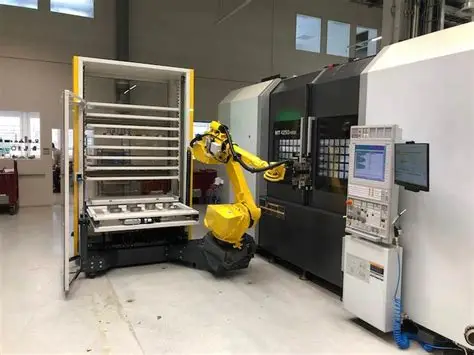
Future Solution: In their demonstrate factory, multiple KUKA robots on linear rails tend various CNC machines (lathes, mills) in a fully networked cell. The robots handle everything from loading raw material and changing pallets to performing post-machining deburring. All machines are connected to the cloud via the KUKA Connect platform, enabling real-time monitoring, data analysis, and predictive maintenance.
-
Outcome: This created a highly automated, flexible production island with dramatically reduced manual labor. The cloud connectivity allows engineers to diagnose issues remotely, optimize cycle times based on data analytics, and simulate changes via a digital twin, embodying the Industry 4.0 ideal.
Case Study 3: The AI-Driven Adaptive Finishing System
-
Challenge: An automotive foundry struggled with manually finishing complex castings, which was labor-intensive, inconsistent, and created a bottleneck.
-
Future Solution: The company deployed a robotic cell equipped with a force-controlled grinding tool and 3D scanning. The robot first scans the casting to create a real-time 3D model, comparing it to the nominal CAD data. Its AI-driven path planning software then generates an optimized deburring and grinding path. During execution, the force sensor provides feedback to ensure consistent material removal regardless of casting variance.
-
Outcome: The system automated a skilled manual task, achieving consistent quality and doubling throughput. It exemplifies the shift from robots as simple “muscle” to intelligent “craftsmen” capable of handling variability, a key driver behind the increasing adoption of adaptive robots.
Looking Ahead: The Horizon of Embodied AI and Sustainable Manufacturing
The trajectory points toward even greater integration and intelligence. The concept of 具身智能 (Embodied AI) in humanoid robots represents a long-term frontier where a general-purpose machine could, in theory, operate any equipment in a factory, offering ultimate flexibility. While current industrial applications are limited, major manufacturers are actively exploring their potential for logistics and assembly tasks.
Simultaneously, the drive for sustainability is shaping the future of manufacturing robotics. AI-optimized processes are reducing energy consumption and material waste. The successful adoption of these advanced systems hinges on workforce transformation. The demand is shifting from manual laborers to robot programmers, data analysts, and cell supervisors, necessitating significant investment in new robotics training programs.
Conclusion: Partnering for the Intelligent Factory
Useful background before committing capital to anything: the history of factory robotics.
The future of manufacturing robotics is a cohesive ecosystem of perceptive, precise, and interconnected machines that amplify human potential and manufacturing capability. For CNC machining specialists, this future offers a path to overcome the traditional trade-offs between flexibility, precision, and cost.
Navigating this transition requires a partner with expertise in both precision engineering and advanced system integration. At JLYPT, we are at the forefront of implementing these intelligent automation solutions. We understand that the factory of the future is built today through strategic integration of robotics, AI, and digital connectivity.
Ready to explore how the future of robotics can transform your precision machining operations? Contact JLYPT to discuss integrating intelligent, agile robotic cells into your production line. Visit our service page to learn more: JLYPT CNC Machining Services.
For the standard behind this: ASTM E18-22 covers Rockwell hardness of metallic materials.
Gear backlash allowance is usually the line item that moves cost most on parts like these. Send the drawing and quantity through the quote page and the number reflects it rather than a flat shop rate. Process detail sits on the robotics machining capability.