
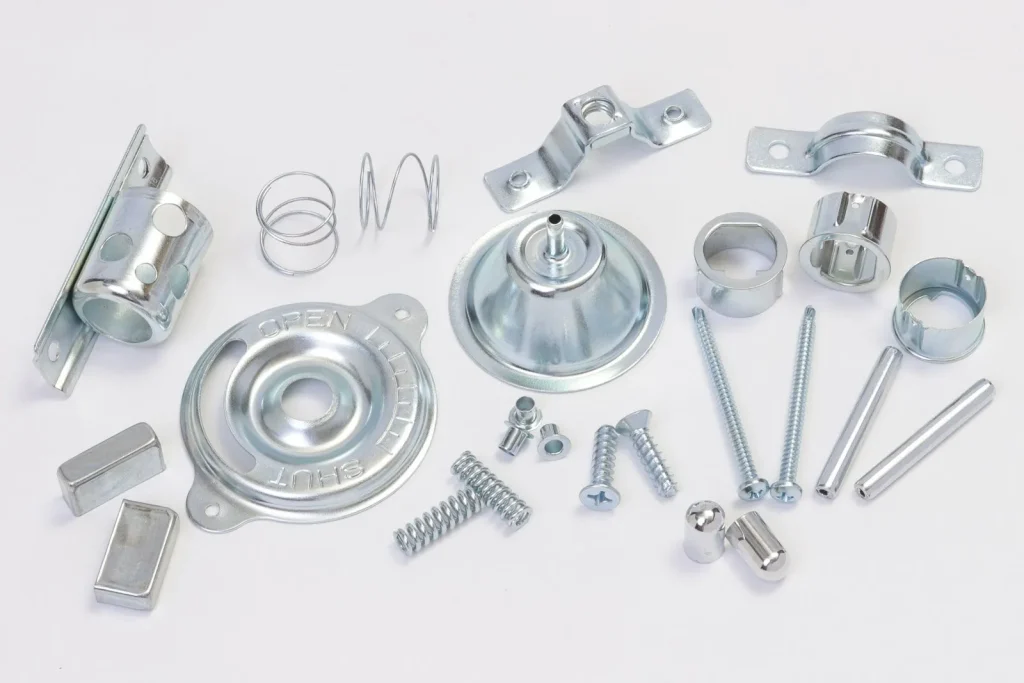
Zinc Plating Service for Steel Parts: Complete Corrosion Protection for CNC Machined Components
Zinc plating service for steel parts remains the most cost-effective corrosion protection method for CNC machined components across automotive, construction, electronics, and industrial manufacturing sectors. At JLYPT, we deliver ASTM B633-compliant zinc electroplating with precise thickness control from 5 to 25 microns, offering clear, yellow, and black chromate finishes that balance corrosion resistance, appearance, and environmental compliance.
Steel components emerging from precision CNC machining operations face immediate oxidation risks. Raw steel develops visible rust within hours of atmospheric exposure, compromising dimensional accuracy, mechanical properties, and aesthetic appearance. Our zinc plating service for steel parts provides a sacrificial barrier layer that protects the underlying steel substrate through both barrier protection and galvanic action, extending component service life from weeks to years depending on environmental conditions.
Zinc Plating Process Fundamentals
Electrolytic zinc deposition transfers zinc ions from aqueous solution onto steel cathode surfaces through electrical current. Unlike autocatalytic processes, zinc plating service for steel parts requires conductive substrates and external power supply, enabling rapid deposition rates (15-30 microns per hour) and excellent process control through current density manipulation.
The fundamental electrochemical reaction occurs at the cathode (steel part):
Zn²⁺ + 2e⁻ → Zn⁰
Simultaneously at the anode (pure zinc or dimensionally stable anode):
Zn⁰ → Zn²⁺ + 2e⁻ (soluble zinc anodes)
Current efficiency typically ranges from 85-95%, meaning most electrical energy contributes to zinc deposition rather than parasitic reactions. This efficiency enables predictable coating thickness based on Faraday’s laws, each ampere-minute deposits approximately 0.02 grams of zinc per square decimeter.
Bath Chemistry Options
Modern zinc plating utilizes three primary electrolyte systems, each offering distinct advantages:
Alkaline Non-Cyanide Zinc: The industry standard for environmental compliance and worker safety. Potassium or sodium zincate solutions with proprietary additives deliver bright, ductile deposits suitable for most applications. Operating pH 12-14 provides excellent throwing power, the ability to plate recessed areas and complex CNC machined geometries uniformly. Bath composition includes brighteners (organic compounds producing reflective finishes), grain refiners (controlling crystal structure), and stress reducers (preventing internal tension).
Acid Chloride Zinc: High-speed plating chemistry delivering deposition rates up to 40 microns per hour. Acidic pH (4-6) suits high-volume production where throughput drives economics. However, throwing power limitations make acid zinc less suitable for complex CNC machined parts with deep recesses or blind holes. Primary applications include flat steel stampings, simple brackets, and wire products.
Zinc-Nickel Alloy: Premium option for severe corrosion environments. Co-depositing 12-15% nickel with zinc creates an alloy coating exhibiting 3-5× the corrosion resistance of pure zinc. Automotive underbody components, brake system parts, and marine hardware benefit from zinc-nickel’s superior performance. The alloy’s higher melting point (compared to pure zinc) also provides better heat resistance for powder coating or e-coating pre-treatment.
At JLYPT, our zinc plating primarily employs alkaline non-cyanide chemistry, balancing environmental responsibility with technical performance across diverse CNC machined component geometries.
ASTM B633 Specification Requirements
| Classification | Coating Type | Thickness (μm) | Chromate Finish | Salt Spray Hours (NSS) | Typical Applications | RoHS Compliance |
|---|---|---|---|---|---|---|
| SC 1 | Zinc | 5 minimum | None or supplementary | 12-24 hours | Indoor mild environments | Yes |
| SC 2 | Zinc | 8 minimum | Trivalent clear/yellow | 96-120 hours | General industrial use | Yes |
| SC 3 | Zinc | 12 minimum | Trivalent yellow | 200-400 hours | Outdoor exposure | Yes |
| SC 4 | Zinc | 25 minimum | Trivalent yellow/olive | 500+ hours | Marine, automotive | Yes |
| Type II | Zinc-Nickel (12-15% Ni) | 5-8 minimum | Trivalent clear/black | 500-1000 hours | Automotive chassis, brake | Yes |
| Type III | Zinc-Iron (0.5-1.2% Fe) | 8-15 minimum | Trivalent yellow | 300-600 hours | Fasteners, heavy equipment | Yes |
Chromate Passivation Systems
Post-plating chromate conversion treatments significantly enhance corrosion protection and appearance in zinc plating:
Trivalent Clear Chromate
- Transparent blue-white iridescent finish
- Minimal appearance change from base zinc
- 96-200 hour salt spray protection
- RoHS and REACH compliant (Cr³⁺ chemistry)
- Suitable for subsequent painting or powder coating
Trivalent Yellow Chromate
- Golden yellow to bronze appearance
- 200-500+ hour salt spray protection
- Enhanced corrosion resistance for outdoor applications
- Color consistency requires tight process control
- Industry standard for commercial/industrial products
Trivalent Black Chromate
- Dark gray to black decorative finish
- 96-300 hour salt spray protection
- Aesthetic appeal for consumer products
- Lower corrosion resistance than yellow chromate
- Popular for automotive trim, hardware, fasteners
Hexavalent Chromate (Legacy): JLYPT has completely transitioned away from hexavalent chromium (Cr⁶⁺) passivation due to environmental regulations and worker safety concerns. While offering superior corrosion protection (1000+ hours), hexavalent chromates face restrictions under RoHS, REACH, and EPA guidelines. Our trivalent chromate zinc plating delivers equivalent performance for most applications while maintaining regulatory compliance.
Pre-Treatment Sequences
Surface preparation determines coating adhesion, appearance, and corrosion protection effectiveness. CNC machined steel parts carry diverse contaminants requiring systematic removal:
Cleaning Protocol
Vapor Degreasing or Solvent Cleaning: Parts with heavy machining oils or cutting fluids begin with vapor degreasing using modified alcohol solvents. This step removes bulk contamination without introducing water that could cause flash rusting on bare steel.
Alkaline Electrocleaning: Immersion in hot alkaline solution (60-80°C) with applied cathodic current (2-6 A/dm²) provides deep cleaning action. Gas evolution at the part surface mechanically lifts embedded particles and emulsifies residual oils. For heavily soiled CNC machined components, we employ reverse-current cleaning (periodic anodic pulses) to prevent metal smut redeposition.
Acid Activation: Steel parts require oxide film removal immediately before zinc plating service. Hydrochloric acid (10-15% concentration) or sulfuric acid (5-10%) dissolves iron oxides and mill scale, exposing fresh metallic surface. Activation time varies by substrate condition, typically 30-120 seconds for clean CNC machined parts, up to 5 minutes for heavily oxidized surfaces.
Critical control point: Steel parts must enter the zinc plating bath within 30 seconds of acid activation to prevent flash rusting. Our automated conveyor systems minimize air exposure between process tanks.
Material-Specific Considerations
Low-Carbon Steel (1018, 1045): Standard pre-treatment sequence provides excellent results. These steels exhibit minimal hydrogen embrittlement risk at typical zinc plating service current densities.
High-Carbon/Alloy Steel (>0.40% C, 4140, 4340): Parts hardened above 40 HRC face hydrogen embrittlement risks. We implement mandatory post-plating bake cycles (190-210°C for 3-23 hours within 4 hours of plating) to drive out absorbed hydrogen before it causes delayed cracking.
Cast Iron/Ductile Iron: Graphite flakes in cast iron require specialized pre-treatment. Extended alkaline cleaning with mechanical agitation removes graphite smearing. Some applications benefit from copper strike (thin copper flash) before zinc plating to ensure uniform coverage over the heterogeneous substrate.
Stainless Steel: While technically steel, stainless grades rarely receive zinc plating due to passive film challenges and marginal corrosion protection benefits. When required, aggressive activation (hydrofluoric-nitric acid or Wood’s nickel strike) precedes zinc deposition.
Barrel vs. Rack Plating Methods
Processing method selection impacts coating uniformity, production efficiency, and cost structure:
Barrel Plating Process
Optimal for
- Small parts (<100mm maximum dimension)
- High-volume production (thousands of pieces)
- Simple geometries without critical appearance requirements
- Fasteners, stampings, small brackets, clips
Process mechanics: Parts tumble inside a perforated hexagonal or oblate barrel rotating in the plating tank. Electrical contact occurs through dangler bars or internal contacts. Tumbling action promotes uniform current distribution and prevents part nesting, though some contact marking is inevitable.
Thickness variation: ±20-30% typical across part population due to current shielding and contact point variations. For precision CNC machined components requiring tight thickness tolerances, barrel plating presents limitations.
Production rates: Single barrel processes 5-50 kg per cycle depending on part size and density. Automated barrel lines achieve impressive throughput, 10,000+ small fasteners per hour including pre-treatment and chromate passivation.
Cost efficiency: Lowest labor cost per part due to bulk processing. Setup time minimal since parts load quickly without individual fixturing.
Rack Plating Process
Optimal for
- Large parts (>100mm dimension)
- Complex CNC machined geometries
- Critical appearance requirements
- Low-to-medium production volumes
- Parts requiring specific thickness control
Process mechanics: Individual parts mount on conductive fixtures (racks) designed for optimal current distribution. Rack design considers part geometry, required thickness zones, and drainage requirements. Our zinc plating maintains dedicated rack inventory for common CNC machined component configurations.
Thickness control: ±10-15% achievable through rack design optimization and current density management. Strategic positioning of auxiliary anodes addresses low-current-density areas.
Production rates: Cycle time includes manual loading/unloading labor. Typical production: 50-500 parts per 8-hour shift depending on complexity.
Cost structure: Higher labor input per part offset by superior quality control and coating uniformity. Precision CNC machined components justify the rack plating investment through reduced rejection rates.
Technical Performance Data
| Property | Pure Zinc Coating | Zinc-Nickel Alloy | Zinc-Iron Alloy | Test Standard |
|---|---|---|---|---|
| Deposit Hardness | 80-140 HV | 300-450 HV | 150-250 HV | ASTM E384 |
| Melting Point | 420°C | 500-650°C | 450-500°C | DSC Analysis |
| Corrosion Protection (NSS) | 96-400 hours | 500-1000 hours | 300-600 hours | ASTM B117 |
| Hydrogen Embrittlement Risk | Low-Moderate | Moderate-High | Moderate | ASTM F519 |
| Weldability | Good (remove coating) | Poor | Fair | AWS Standards |
| Paintability | Excellent with chromate | Excellent | Excellent | ASTM D3359 |
| Solderability | Poor | Poor | Poor | MIL-STD-883 |
| Electrical Conductivity | 27% IACS | 8-12% IACS | 15-20% IACS | ASTM B193 |
| Thermal Stability | <200°C | <250°C | <220°C | TGA Analysis |
| Typical Thickness Range | 5-25 microns | 5-15 microns | 8-20 microns | XRF/Coulometric |
| Deposition Rate | 15-30 µm/hr | 8-15 µm/hr | 12-20 µm/hr | Process Control |
| Current Efficiency | 85-95% | 75-85% | 80-90% | Faraday Calculation |
| Throwing Power | Good (alkaline) | Fair | Good | Hull Cell Test |
Three Application Case Studies
Case Study 1: Automotive Bracket Assemblies – AISI 1018 Steel
Project Background: Tier-2 automotive supplier manufactured suspension mounting brackets via CNC machining from AISI 1018 cold-rolled steel. Previous zinc plating service provider delivered inconsistent coating thickness (8-18 microns measured range vs. 12±2 micron specification), causing assembly interference issues and field corrosion failures in salt-belt regions.
Component Specifications
- Material: AISI 1018 CR steel, as-machined
- Dimensions: 145mm × 85mm × 35mm with complex mounting geometry
- Critical features: M10×1.5 threaded holes (4 locations), ±0.05mm perpendicularity requirement
- Coating requirement: ASTM B633 SC3, 12-15 micron zinc with yellow chromate
- Annual volume: 180,000 pieces across 12 part numbers
- Performance target: 500 hours neutral salt spray without red rust
Technical Challenges Identified
Threaded hole coating control: Previous supplier’s barrel plating process deposited 15-22 microns inside threaded holes, requiring post-plating thread chasing that damaged chromate passivation. Thread gauges frequently rejected parts due to over-plating.
Thickness distribution: Barrel tumbling created wide thickness variation, outer edges received 15-18 microns while recessed areas measured 8-10 microns, failing to meet minimum specification uniformly.
Chromate adhesion: Inadequate post-plating rinsing left alkaline residue that interfered with chromate conversion, creating blotchy appearance and reduced corrosion protection.
Solution Implementation
Process redesign for rack plating: We transitioned these brackets from barrel to rack zinc plating despite higher piece cost. Custom-designed racks held 24 brackets per load, with spring-loaded contact points ensuring reliable electrical connection to all critical surfaces.
Selective masking protocol: High-temperature silicone plugs protected threaded holes during zinc deposition. Plug design allowed complete thread protection while maintaining process flow, installation took 8 seconds per bracket, removal 6 seconds using pneumatic extraction tools.
Current density optimization: Hull cell testing determined optimal current density of 2.5 A/dm² for this geometry. We implemented programmable rectifiers with three-stage plating cycle:
- Initial strike: 1.5 A/dm² for 2 minutes (ensures complete coverage)
- Main deposition: 2.5 A/dm² for 18 minutes (builds target thickness)
- Final leveling: 2.0 A/dm² for 3 minutes (smooths surface, reduces roughness)
Enhanced rinse sequence: Five-stage rinse cascade (static rinse, overflow rinse, DI spray, DI immersion, final DI spray) reduced dragout and eliminated alkaline contamination. Conductivity monitoring verified <5 µS/cm before chromate passivation.
Statistical process control: Real-time thickness monitoring via XRF measurement on designated witness locations (5 points per rack). Automated data logging created control charts showing process capability index (Cpk) of 1.67 for thickness distribution.
Results Achieved
All production brackets met 12-15 micron specification with actual distribution of 12.8-14.2 microns across measured points (±5.5% variation vs. previous ±35%). Threaded holes accepted mating fasteners without thread damage or interference. Salt spray testing demonstrated 650-hour average protection before red rust appearance, exceeding 500-hour requirement by 30%.
Most significantly, field warranty claims related to corrosion dropped from 47 incidents per 100,000 vehicles to zero over 18-month tracking period. Customer expanded zinc plating contract to include entire bracket family (34 part numbers) based on documented quality improvement.
Manufacturing cost increased 0.85perbracketversusbarrelplating,buteliminationofpost−platingthreadrepair(0.85perbracketversusbarrelplating,buteliminationofpost−platingthreadrepair(1.20 labor cost) and reduced rejection rate (from 6.5% to 0.3%) created net savings of $0.68 per part plus warranty cost avoidance.
Case Study 2: Industrial Fastener Production – SAE Grade 8 Bolts
Project Background: Construction equipment manufacturer required zinc plating covering high-strength Grade 8 bolts (SAE J429, 150 ksi minimum tensile strength) used in critical structural connections. Application involved outdoor exposure with 10-year service life expectation in moderate corrosion environments.
Component Specifications
- Material: AISI 4140 alloy steel, quenched and tempered to 33-38 HRC
- Sizes: M12×1.75×60mm through M20×2.5×120mm (8 size variants)
- Coating requirement: ASTM B633 SC2, 8-12 micron zinc with clear trivalent chromate
- Hydrogen embrittlement class: Not allowed per ASTM F1940
- Annual volume: 2.4 million fasteners total
- Performance target: Zero delayed failures, 200+ hours salt spray
Technical Challenges
Hydrogen embrittlement prevention: High-strength steel fasteners represent the highest-risk category for hydrogen damage. Previous zinc plating service provider experienced 0.08% delayed failure rate during sustained load testing, unacceptable for structural applications where single bolt failure could cause catastrophic equipment collapse.
Thread tolerance maintenance: Grade 8 bolts require 2A thread tolerance class. Zinc coating thickness must not cause thread gauging rejection or assembly torque deviation.
High-volume production efficiency: Daily production volume of 9,600 fasteners demanded optimized cycle time without sacrificing quality or embrittlement prevention measures.
Solution Implementation
Barrel plating with embrittlement protocol: Given high production volume and relatively simple geometry, barrel zinc plating offered optimal economics. We implemented comprehensive hydrogen embrittlement prevention:
Pre-plate shot peening: All fasteners received controlled shot peening (0.008-0.012″ arc height) before zinc plating. Surface compressive stress layer (80-120 ksi) retards hydrogen diffusion into tensile-stressed core regions.
Low-current-density plating: Reduced current density from standard 3 A/dm² to 1.8 A/dm² slowed deposition rate, allowing hydrogen gas evolution at the surface rather than absorption into steel matrix. Plating time increased from 25 to 38 minutes per cycle, but embrittlement risk decreased substantially.
Immediate post-plate bake: Automated conveyor transferred barrels directly from final rinse to bake oven with <90 second air exposure. Baking protocol: 200°C for 8 hours, meeting ASTM F1941 requirements for Grade 8 fasteners. This thermal treatment drives absorbed hydrogen out of steel before it migrates to high-stress regions.
Embrittlement testing verification: Every production lot underwent ASTM F1624 testing, sustained load testing at 75% of minimum specified yield strength for 200 hours. Zero failures across 450 test samples (representing 1.8 million production fasteners) validated process effectiveness.
Thread coating control: Thread masking proved impractical for high-volume barrel processing. Instead, we optimized barrel rotation speed (8 RPM vs. standard 12 RPM) and reduced plating time to deposit 8-10 microns on threads versus 10-12 microns on head/shank. Post-plate thread rolling lightly compressed coating into thread roots, improving adhesion while maintaining 2A thread tolerance.
Quality assurance protocol
- XRF thickness measurement: 5 fasteners per barrel, 3 measurement locations each
- Thread gauge verification: Go/No-Go gauging on 10 fasteners per barrel
- Salt spray testing: Weekly validation runs (200+ hour requirement)
- Torque-tension testing: Confirming installation performance matches uncoated baseline
- Metallurgical cross-section: Monthly validation of coating structure and hydrogen content
Results Achieved
Production throughput stabilized at 9,800 fasteners per day across two automated barrel lines. Coating thickness distribution measured 8.2-11.8 microns with Cpk 1.45. Thread gauge acceptance rate: 99.7% (reject rate 0.3% primarily due to pre-existing CNC threading variations, not coating issues).
Most critically, zero hydrogen embrittlement failures occurred across 18-month production period representing 3.2 million fasteners. Field service tracking (construction equipment operating in northern U.S. salt exposure) showed <0.01% corrosion-related bolt replacement over 3-year monitoring period.
Customer achieved total cost reduction of $0.09 per fastener through improved yield, eliminated field failures, and extended equipment service intervals. Our zinc plating became qualified supplier for entire fastener product line including Grade 5 and Grade 8.8 metric variants.
Case Study 3: Precision CNC Machined Steel Housings – 4140 Alloy Steel
Project Background: Hydraulic equipment manufacturer CNC machined complex valve housings from 4140 alloy steel bar stock, requiring corrosion protection for outdoor industrial service while maintaining tight dimensional tolerances for internal valve components.
Component Specifications
- Material: AISI 4140 alloy steel, normalized condition (22-28 HRC)
- Dimensions: 95mm × 75mm × 65mm rectangular housing with internal passages
- Critical features: Ø18H7 bore tolerance (+0.018/0), four M6×1.0 threaded ports
- Surface finish: Ra 1.6 µm maximum on sealing surfaces
- Coating requirement: 8-12 micron zinc-nickel alloy with black trivalent chromate
- Annual volume: 12,000 housings
- Performance target: 800+ hours salt spray, aesthetic black finish
Technical Challenges
Dimensional tolerance preservation: H7 bore tolerance provided only 18 microns total tolerance band. Zinc coating thickness variation could not exceed ±3 microns on this critical surface to maintain fit with mating valve spool.
Internal passage coating: Intersecting drilled passages (Ø8mm cross-holes) required uniform zinc plating coverage to prevent internal corrosion that could contaminate hydraulic fluid.
Sealing surface finish: Zinc deposits typically exhibit 1-2 micron surface roughness increase versus base metal. Housing sealing surfaces required post-plate finishing to maintain Ra 1.6 requirement for O-ring sealing.
Zinc-nickel appearance uniformity: Black chromate finish demanded consistent alloy composition (13-15% nickel) and current density control to achieve uniform black color across production batches.
Solution Implementation
Rack plating with selective current control: Custom-designed racks positioned housings to optimize current distribution. Strategic placement of auxiliary zinc-nickel anodes inside internal passages ensured adequate current density in recessed areas.
Bore protection strategy: Rather than masking (which creates sharp coating transition at mask edges), we specified plating to lower thickness target (8-10 microns) on bore surfaces through rack geometry optimization. Placing bore perpendicular to anode position created lower current density, naturally reducing deposit thickness. Post-plating honing (3-minute cycle per housing with 400-grit diamond stones) removed 4-6 microns, bringing bore to final dimension while improving surface finish to Ra 0.8-1.2 µm.
Zinc-nickel alloy control: Our zinc plating employs proprietary alkaline zinc-nickel chemistry maintaining 13.5-14.5% nickel in deposit. Real-time monitoring:
- Cyclic voltammetry analysis every 4 hours confirming nickel ratio
- Hull cell testing at shift start validating appearance and coverage
- Atomic absorption spectroscopy daily verification of bath composition
Current density optimization at 2.2 A/dm² delivered consistent alloy composition across complex housing geometry.
Black chromate passivation: Trivalent black chromate process required precise pH (1.8-2.2), temperature (40-45°C), and immersion time (45-60 seconds). Automated process control maintained parameters within specification, producing uniform black finish with L* color value of 28-32 (measured via spectrophotometer).
Internal passage verification: Developed specialized inspection protocol using borescope imaging and ultrasonic thickness measurement with custom probe geometries. Statistical sampling (5 housings per 100-piece production lot) confirmed 8-12 micron thickness inside internal passages.
Post-plate finishing sequence
- Bore honing: Diamond stones, 180 RPM, 3 minutes
- Sealing surface lapping: 600-grit compound, 60 seconds
- Deburring: Nylon brush, light pressure
- Final inspection: CMM verification of critical dimensions
Results Achieved
Production housings achieved H7 bore tolerance with 94% first-pass acceptance (6% requiring minor honing adjustment, zero scrap). Internal passages measured 9.2-11.8 micron coating thickness, providing complete corrosion protection. Sealing surfaces maintained Ra 1.4-1.8 µm after finishing operations.
Salt spray testing exceeded 850 hours before white corrosion appearance (zinc-nickel alloy consumption), with no red rust (steel substrate corrosion) observed through 1200+ hour extended testing. Black chromate finish exhibited excellent color uniformity, ΔE <2.5 color variation across production batches, meeting customer aesthetic requirements for assembled valve manifolds.
Field performance tracking over 24 months showed zero corrosion-related warranty claims across 18,000 housings installed in mobile hydraulic systems operating in construction, agriculture, and forestry applications. Customer eliminated previous stainless steel housing design (3× material cost) in favor of zinc-nickel plated 4140 steel, achieving 42% total component cost reduction while maintaining equivalent corrosion performance.
Our integrated approach, combining precision CNC machining with optimized zinc plating, allowed single-source manufacturing responsibility, reducing lead time from 6 weeks (previous multi-supplier coordination) to 12 days for production orders.
Zinc Plating vs. Alternative Coatings
| Coating Method | Corrosion Protection | Cost per dm² | Thickness Uniformity | Processing Time | Environmental Impact | Best Applications |
|---|---|---|---|---|---|---|
| Alkaline Zinc Plating | Good (200-400 hrs NSS) | $0.15-0.35 | Good (±15-25%) | Fast (30-60 min) | Low (non-cyanide) | General industrial steel |
| Zinc-Nickel Alloy | Excellent (800-1000 hrs) | $0.45-0.75 | Good (±15-20%) | Medium (45-90 min) | Low-Medium | Automotive, marine |
| Hot-Dip Galvanizing | Excellent (>1000 hrs) | $0.80-1.50 | Poor (±40-60%) | Fast (5-10 min) | Medium (fumes) | Structural steel, outdoors |
| Mechanical Galvanizing | Very Good (500-800 hrs) | $0.25-0.55 | Fair (±25-35%) | Medium (30-60 min) | Low | Fasteners, no hydrogen embrittlement |
| Electroless Nickel | Excellent (1000+ hrs) | $1.20-2.50 | Excellent (±10%) | Slow (60-120 min) | Medium (chemistry) | Precision components |
| Powder Coating | Fair (requires zinc base) | $0.40-0.80 | Good (±20%) | Medium (cure time) | Low (no VOC) | Decorative, thick coating |
| E-Coating (KTL) | Excellent (800+ hrs) | $0.50-1.00 | Excellent (±10%) | Medium (cure time) | Low | Automotive bodies |
Zinc plating service for steel parts offers the optimal balance of corrosion protection, processing cost, and production efficiency for most CNC machined steel components. When compared to our custom aluminum anodizing services for aluminum substrates, zinc plating provides equivalent protection levels at lower cost for ferrous materials.
Quality Control and Testing
JLYPT implements comprehensive testing protocols ensuring consistent coating performance:
Pre-Production Validation
- First Article Inspection (FAI) with dimensional verification
- Hull cell testing confirming bath performance
- Witness panel plating for thickness/appearance reference
- Chromate conversion verification on test specimens
In-Process Monitoring
- Current density measurement every 30 minutes
- Bath analysis (zinc content, pH, conductivity) every 4 hours
- Visual inspection during processing for coverage issues
- Temperature verification (±2°C tolerance)
Post-Plating Verification
- XRF thickness measurement (minimum 5 points per part or 3% of lot)
- Adhesion testing per ASTM B571 (bend test, tape test)
- Chromate coating weight per ASTM B201
- Salt spray testing per ASTM B117 (lot qualification)
- Hydrogen embrittlement testing per ASTM F1624 (high-strength steel)
Documentation Package
- Certificate of Compliance with ASTM B633 classification
- Thickness measurement data with location mapping
- Process parameter records (current, time, temperature)
- Salt spray test results (when specified)
- Material traceability from steel lot through plating batch
Design Guidelines for Plated Components
Optimize CNC machined component design for successful zinc plating:
Thickness Allowances
- Standard zinc coating adds 8-12 microns per surface
- Account for ±0.012-0.025mm dimensional change on coated features
- Threaded holes: Specify 2B thread class minimum to accommodate coating
- Shaft fits: Design clearance accounting for coating on both mating surfaces
Geometric Considerations
- Avoid blind holes <3:1 depth-to-diameter ratio (poor coating penetration)
- Provide drainage holes in cup-shaped features (minimum Ø3mm)
- Specify corner radii >0.5mm (sharp edges plate thinner)
- Include air vent paths in enclosed geometries
Racking Points
- Designate contact areas for rack fixturing (non-critical surfaces)
- Minimum 5mm × 5mm flat area for reliable electrical contact
- Accept slight marking at contact points (unavoidable in rack plating)
Material Selection
- Specify low-hydrogen-embrittlement steels when possible (1018, 1045 vs. 4140, 4340)
- For high-strength steel (>180 ksi tensile), evaluate mechanical galvanizing alternative
- Consider zinc-nickel alloy for severe corrosion environments
Our engineering team provides design for manufacturability (DFM) reviews, identifying coating challenges before CNC machining begins. Early collaboration prevents costly redesigns and optimizes both machining and zinc plating processes.
Environmental Compliance and Sustainability
JLYPT zinc plating maintains strict environmental standards:
Wastewater Treatment
- Closed-loop rinse water recycling reduces consumption by 65%
- pH neutralization and metal precipitation before discharge
- Effluent monitoring meeting EPA and local POTW requirements
- Zero hazardous waste classification through proper management
Chemistry Selection
- 100% alkaline non-cyanide zinc formulations (eliminated cyanide hazard)
- Trivalent chromate passivation (RoHS/REACH compliant)
- Low-ammonia formulations reducing atmospheric emissions
Energy Efficiency
- Heat recovery systems capturing bath heating energy
- LED lighting throughout facility
- Variable-frequency drives on pumps and ventilation
- Rectifier efficiency >90% (switch-mode power supplies)
Certifications
- ISO 14001 Environmental Management System
- RoHS compliance certification
- REACH SVHC declaration available
- Conflict minerals reporting
Lead Time and Production Capacity
Standard Production Schedule
- Prototype/small batch (1-100 parts): 3-5 working days
- Production runs (100-1000 parts): 5-8 working days
- Volume production (1000-10,000 parts): 8-12 working days
- High-volume contracts (>10,000 parts): 12-18 working days
Expedited Options
- 48-hour rush service available (capacity permitting)
- Same-day processing for emergency rework/repair (limited quantities)
Facility Capacity
- Barrel plating: 5000 kg daily capacity across four automated lines
- Rack plating: 1200 dm² daily capacity with custom rack fabrication
- Maximum part size: 1200mm × 800mm × 600mm
- Maximum part weight: 150 kg individual piece
Request Your Quote
Accurate quotations require specific information:
- Part drawings or 3D models (PDF, STEP, IGES formats)
- Material specification with hardness/heat treatment condition
- Quantity requirements (initial order and projected annual volume)
- Coating specification:
- ASTM B633 service condition class (SC1-SC4)
- Chromate finish preference (clear, yellow, black)
- Thickness requirement (if different from standard)
- Special testing requirements
- Critical dimensions requiring tolerance control
- Application description (corrosion environment, service life expectation)
Our technical sales team responds within 24 hours with detailed quotations including process recommendations, lead times, and cost optimization suggestions.
Why Choose JLYPT
Technical Expertise
- 15+ years specializing in precision steel component finishing
- Metallurgical engineering support for coating specification
- Process development for challenging geometries
- Hydrogen embrittlement prevention expertise
Quality Systems
- ISO 9001:2015 certified operations
- IATF 16949 automotive quality management (in process)
- ASTM B633 compliant processes with full documentation
- Statistical process control on critical parameters
Integrated Manufacturing
- Combined CNC machining and zinc plating
- Single-source responsibility for dimensional accuracy
- Optimized design collaboration
- Reduced total lead time through vertical integration
Application Experience
- Automotive chassis and suspension components
- Industrial fasteners (Grade 2 through Grade 8)
- Hydraulic valve bodies and manifolds
- Construction equipment brackets and fittings
- Agricultural machinery parts
- Electronics enclosures and shielding
Customer Support
- Design for manufacturability consultation
- Sample plating evaluation programs
- Corrosion testing and failure analysis
- Ongoing technical support
Frequently Asked Questions
What zinc plating thickness do I need?
Thickness follows the ASTM B633 service condition classes: SC 1 (5 μm) for indoor mild environments, SC 2 (8 μm) for general industrial use, SC 3 (12 μm) for outdoor exposure, and SC 4 (25 μm) for marine or heavy-duty applications. Most CNC machined steel parts fall in the SC 2–SC 3 range.
Clear or yellow chromate — which finish should I choose?
Clear (blue) trivalent chromate offers a bright, low-profile appearance with 96–200 hours of salt spray protection and suits parts that will be painted later. Yellow chromate delivers 200–400 hours of protection and is the standard choice for fasteners and outdoor hardware.
Is trivalent chromate RoHS compliant?
Yes. Trivalent (Cr³⁺) passivation avoids hexavalent chromium entirely and meets RoHS, REACH, and EPA restrictions while matching legacy hexchromate performance for most applications.
Does zinc plating risk hydrogen embrittlement?
High-strength steels above roughly 1,000 MPa tensile strength carry embrittlement risk during acid pickling and plating. We mitigate this with alkaline pre-treatment and mandatory post-plating baking per ASTM B850, typically 4–8 hours at 190–220 °C within 4 hours of plating.
What is your typical lead time?
Quotes go out within 24 hours of receiving drawings and plating specifications. Standard production runs ship in 5–8 working days; expedited 48–72 hour service is available for urgent programs.
Conclusion: Reliable Corrosion Protection Through Zinc Plating
Zinc plating service for steel parts delivers proven, cost-effective corrosion protection for CNC machined components across diverse industrial applications. Whether your requirements demand basic SC2 protection for indoor service or advanced zinc-nickel alloy coatings for automotive underbody exposure, JLYPT provides the technical expertise, quality systems, and production capacity to meet your specifications.
Our integrated approach, combining precision CNC machining capabilities with ASTM B633-compliant zinc plating, ensures dimensional accuracy, coating uniformity, and reliable performance under single-source manufacturing control. From prototype development through high-volume production, we maintain the process discipline and quality verification that your critical applications demand.
Beyond standard zinc coatings, our finishing capabilities include custom aluminum anodizing services for aluminum components, creating a comprehensive surface engineering partnership for your complete product portfolio.
Contact JLYPT today to discuss your zinc plating requirements and discover how our technical expertise can enhance component performance, extend service life, and optimize your manufacturing supply chain.
Referenced standard: ASTM B117-19 covers salt spray (fog) exposure. Test method reference: ASTM E18-22 covers Rockwell hardness of metallic materials.
When quotes are compared side by side, ask each shop how they control plate thickness by service class — the answer shifts the total more than the hourly rate does. Ours runs through the quote page; the process detail is on the electroplating line.