
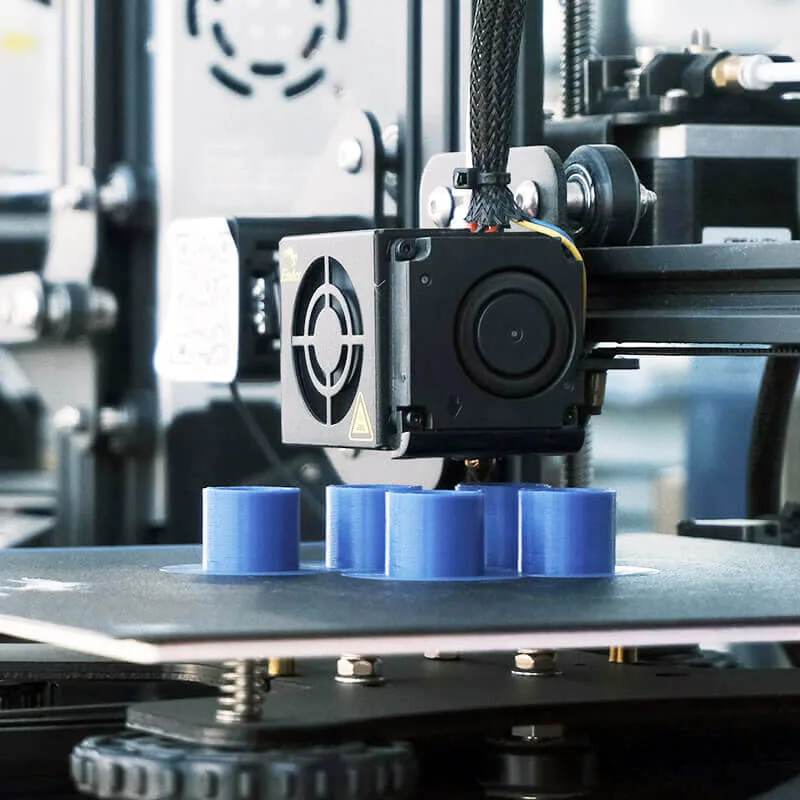
FDM 3D Printing Services
Introduction Fused Deposition Modeling (FDM) has quietly evolved from hobbyist curiosity to factory-floor workhorse. Modern gantry systems reach 400 °C, extrude carbon-filled nylons, and hold ±0.1 mm tolerances, rivaling aluminum machining on geometries that would require five-axis work. At JLYPT we operate 140 industrial FDM cells, including 8 large-format Modix BIG-120X units. This guide walks you through material science, design rules, cost drivers, and three recent case studies that saved clients over $120 k in tooling costs.
Table 1: FDM Materials Overview (2025 Update)
| Grade | Tensile (MPa) | HDT (°C) | Impact (kJ/m²) | Key Features | Typical Uses |
|---|---|---|---|---|---|
| ABS-ESD Black | 42 | 95 | 28 | Static-dissipative | Electronics trays |
| PC-ABS FR | 60 | 110 | 45 | UL94 V-0 | Enclosures, drones |
| PETG-CF | 70 | 75 | 35 | Carbon-stiff | Structural brackets |
| Nylon 12 CF | 110 | 120 | 55 | Light-weight metal substitute | End-use arms |
| TPU 95 A | 35 | 60 | 90 | Fatigue-resistant | Shoe midsoles |
| PEEK | 100 | 250 | 85 | Autoclave sterilizable | Medical tooling |
Table 2: Resolution vs. Build Speed vs. Cost
| Layer Height (mm) | XY Tolerance (±mm) | Speed (mm/s) | Relative Cost | Visual Finish | Best For |
|---|---|---|---|---|---|
| 0.40 | 0.20 | 120 | 1× | Ribbed | Fast draft |
| 0.25 | 0.15 | 80 | 1.3× | Visible layers | Functional test |
| 0.15 | 0.10 | 60 | 1.8× | Light texture | End-use housing |
| 0.10 | 0.08 | 40 | 2.5× | Near-injection | Display models |
| 0.05 | 0.05 | 25 | 4× | Ultra-smooth | Precision jigs |
Design Rules That Matter
1.1 Wall Thickness
- Standard 0.4 mm nozzle → 1.0 mm minimum wall (2 perimeters).
- Carbon-filled grades → 1.5 mm to hide fiber print-through.
1.2 Overhangs & Supports
- Rule of 45° still holds for ABS and PLA; PETG tolerates 55°.
- Use breakaway PLA supports for internal channels, dissolves in warm water.
1.3 Holes & Pins
- Vertical holes: design +0.2 mm Ø to compensate for polygon faceting.
- Horizontal holes: use tear-drop shape to avoid elliptical distortion.
1.4 Threads
- M3–M6: print undersized by 0.15 mm, chase with tap.
- For repetitive assembly, embed brass heat-set inserts at 200 °C.
Large-Format FDM: What Changes?
Our Modix BIG-120X offers 600 × 600 × 600 mm. • Heated chamber 80 °C → eliminates ABS warping up to 400 mm length. • 1.2 mm nozzle cuts print time 70 % on bulky housings. • Downside: ±0.3 mm tolerance; compensate with machining allowance on critical faces.
Table 3: Cost Benchmark: FDM vs. Injection Molding (1,000 pcs)
| Metric | FDM (Nylon CF) | Injection Mold (PA66 GF30) |
|---|---|---|
| Tooling Cost | $0 | $18,000 |
| Part Cost | $8.50 | $1.30 |
| Lead Time | 5 days | 6 weeks |
| Design Change Cost | $0 | $2,000 |
| Break-even Volume | , | 2,500 pcs |
Conclusion: FDM wins below 2,500 units or when design freeze is uncertain.
Post-Processing & Quality Control
| Operation | Equipment | Tolerance Achieved | Typical Adder |
|---|---|---|---|
| CNC facing | Haas VF-2 | ±0.02 mm | $0.10 / cm² |
| Vapor smoothing | Stratasys Vantage | Ra 1.2 µm | $0.05 / cm² |
| Heat-staking inserts | Ultrasonic | ±0.05 mm | $0.03 / insert |
| Tapping threads | Robot arm | 6H fit | $0.08 / hole |
Every batch undergoes: • First-article inspection with Keyence 3D scanner. • In-process laser line sensor for layer adhesion faults. • Final CMM report emailed to client.
Case Studies
Case A , Automotive HVAC Duct Client: Tier-1 EV supplier Challenge: 380 mm long duct, 90 °C service, 200-piece pilot run. Solution: Printed in PC-ABS FR on the BIG-120X, 0.25 mm layers. Split into two shells with tongue-and-groove joints, bonded with methylene chloride. CNC faced the flange interface to ±0.05 mm. Result: Passed FMVSS 302 burn test; saved $38 k in aluminum tooling.
Case B , Wearable Medical Brace Client: Health-tech start-up Challenge: Custom lattice for breathability, TPU 95 A, 50 unique sizes. Workflow:
-
Foot scan → Fusion 360 generative lattice.
-
0.20 mm layers, 100 % infill at load zones.
-
Dye-sublimated straps post-print.
Outcome: 48-hour turnaround per patient, 30 % lighter than traditional foam.
Case C , Food-Grade PETG Dispenser Client: Beverage OEM Challenge: Transparent hopper, 5 L volume, FDA contact. Solution: Printed in crystal-clear PETG with 0.15 mm layers, vapor-polished interior. Threads chased to G 3/4 BSPP. Passed USP VI cytotoxicity. Lead time: 10 days vs. 12-week injection mold.
Pricing & Lead Times
| Build Volume | Layer | ABS | PETG-CF | Nylon-CF | Rush (24 h) |
|---|---|---|---|---|---|
| < 100 cm³ | 0.15 mm | $0.06 / cm³ | $0.09 / cm³ | $0.12 / cm³ | +100 % |
| 100–1,000 cm³ | 0.20 mm | $0.05 / cm³ | $0.07 / cm³ | $0.10 / cm³ | +100 % |
| 1,000–10,000 cm³ | 0.30 mm | $0.04 / cm³ | $0.06 / cm³ | $0.08 / cm³ | +100 % |
| > 10,000 cm³ | Custom | Custom | Custom | Custom | Custom |
Prices include support removal, light sanding, and dimensional report.
Sustainability & Closed-Loop Grinding
• 92 % of support waste is pelletized into RePLA for non-critical jigs. • Heated chambers run on solar thermal pre-heat, cutting kWh by 18 %. • Take-back program shreds end-of-life parts into acoustic panels.
FAQ
Q: Can FDM achieve injection-mold surface? A: Yes, vapor smoothing + 0.10 mm layers reach Ra 1 µm, suitable for consumer electronics.
Q: Maximum overhang without supports? A: 55° for PETG, 45° for ABS. Bridging up to 50 mm at 25 mm/s.
Q: Threaded brass inserts temperature? A: 200 °C for ABS/PC, 180 °C for PLA to avoid deformation.
See also these technical guides: ABS Filament Production Guide 2025 and Complete 3D Printing Materials Guide 2025.
Send the model before the drawing is frozen and feedback covers density and porosity limits while changes are still cheap. The quote form accepts prints and STEP files, and the equipment behind it is listed on the prototyping service.