Industrial Robot Applications: Revolutionizing Modern CNC Machining Through Advanced Automation
The fusion of high-precision CNC machining with versatile industrial robot applications represents the vanguard of modern manufacturing. This synergy is transcending traditional production limitations, creating agile, efficient, and intelligent manufacturing cells. For a precision engineering service provider like JLYPT, leveraging these applications is not merely an operational upgrade; it is a strategic imperative to deliver unparalleled quality, flexibility, and scalability to our clients. This in-depth exploration will dissect the core industrial robot applications within CNC environments, analyze the critical integration technologies, and quantify the transformative impact through detailed case studies and technical data.
1. The Evolution from Isolation to Integration: Robots in the CNC Ecosystem
Historically, CNC machines and industrial robots operated in separate silos—CNC for subtractive precision, robots for material handling. Today, they are components of a unified cyber-physical system. This evolution is driven by market demands for:
-
High-Mix, Low-Volume (HMLV) Production: Responding to customized demand without sacrificing efficiency.
-
Unmanned and Lights-Out Manufacturing: Maximizing capital asset utilization beyond human shift patterns.
-
Superior Consistency and Traceability: Eliminating human variability in repetitive tasks and ensuring full process documentation.
Modern industrial robot applications in machining bridge the gap between the digital design (CAD/CAM) and physical part, handling everything from raw billet to finished, inspected component.
2. Core Application Domains in Precision Machining
The deployment of robots within a CNC workflow can be categorized into several key domains, each addressing specific bottlenecks and value-adding opportunities.
2.1. Automated Machine Tending & Palletized Production
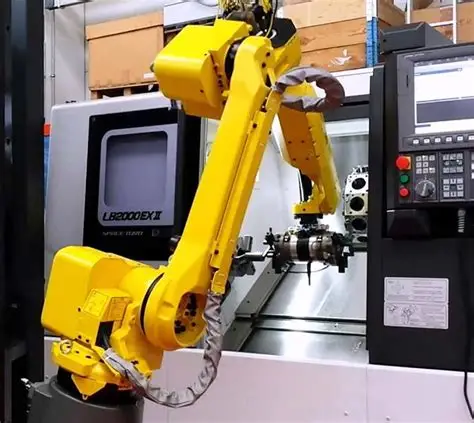
This is the most prevalent application, where robots automate the loading of raw material and unloading of finished parts.
-
Technology & Integration: Systems utilize 6-axis articulated robots or gantry-style robots integrated with CNC machine door interlocks and pallet changers. Advanced cells employ machine vision (e.g., Keyence or Cognex systems) for bin-picking unstructured raw stock or verifying part orientation.
-
Impact: It directly increases spindle uptime by 20-40%, eliminates ergonomic risks from handling heavy workpieces, and enables continuous production through pallet pools. A single robot can often tend multiple CNC machines, creating a highly efficient work cell.
2.2. Secondary Process Automation: Deburring, Finishing, and Polishing
Robots excel at performing consistent, quality-critical finishing operations that are difficult to automate with traditional CNC.
-
Technology & Integration: This requires force/torque sensors (like those from ATI Industrial Automation) and compliant end-effectors. The robot path is programmed for contour following, with the sensor providing real-time feedback to maintain constant tool pressure. For complex surfaces, CAD-to-path offline programming software (e.g., Robotmaster, SprutCAM Robot) is essential.
-
Impact: Achieves unmatched consistency in surface finish (Ra values), eliminates the variability of manual labor, and allows for the processing of complex geometries impossible with fixed tools.
2.3. In-Line Metrology and Quality Assurance
Integrating measurement directly into the automated cell enables closed-loop process control.
-
Technology & Integration: Robots are equipped with touch-trigger probes (Renishaw RMP60) or non-contact laser scanners (GOM Atos). They perform post-process inspection, comparing measured dimensions against the CAD model. Data is fed back to the CNC controller or a Statistical Process Control (SPC) system for real-time tool offset compensation or trend analysis.
-
Impact: Facilitates 100% inspection for critical features, enables predictive maintenance by tracking tool wear, and creates a digital quality record for each part, crucial for aerospace (AS9100) and medical (ISO 13485) certifications.
2.4. Direct Robotic Machining (Milling, Drilling, Routing)
For large, complex, or soft materials (composites, foam, wood), robots can act as the machining platform itself.
-
Technology & Integration: This demanding application requires high-stiffness robotic arms (e.g., KUKA Quantec KR 210 R3100 ultra) and spindle units mounted as end-of-arm tools. Dynamic path compensation and vibration damping algorithms are critical to counteract the robot’s lower static stiffness compared to a CNC gantry. Solutions like Siemens SINUMERIK Run MyRobot provide CNC-grade control to the robot, significantly enhancing path accuracy.
-
Impact: Provides an economical solution for machining very large parts (e.g., composite aircraft skins, boat hull molds) where a large-footprint CNC machine would be cost-prohibitive.
Table 1: Technical Comparison of Primary Industrial Robot Applications in CNC Machining
| Application | Key Robot Requirements | Critical Peripheral Systems | Primary CNC Benefit | Typical Industry Use Case |
|---|---|---|---|---|
| Machine Tending | Medium to high payload (50-500 kg), high repeatability (±0.05 mm). | Pallet changers, machine interlock I/O, part grippers (mechanical/vacuum), vision guidance. | Maximized spindle uptime, labor reduction. | Automotive castings, aerospace structural components. |
| Deburring & Finishing | Lower payload, compatibility with force/torque sensors, continuous path control. | Rotary spindles, abrasive tools, dust extraction, force sensor, offline programming suite. | Consistent quality, reduction in manual rework. | Medical implants, investment castings, precision gears. |
| In-Line Metrology | High positional accuracy, repeatability. | Touch probe or laser scanner, calibration artifacts, SPC software interface. | Closed-loop quality control, process validation. | Aerospace turbines, automotive powertrain components. |
| Direct Machining | Very high stiffness and rigidity, high payload for spindle, advanced controller. | High-frequency spindle, coolant system, specialized CAM for robots. | Large-scale part machining at lower capital cost. | Composite aerospace layup tools, architectural molds. |
3. The Technology Stack: Enabling Precision and Flexibility
Successful implementation hinges on more than just a robot. It requires a sophisticated stack of enabling technologies.
3.1. End-of-Arm Tooling (EOAT) and Gripper Technology
The EOAT is the critical interface. Options include:
-
Mechanical Grippers: For precise gripping of machined features.
-
Vacuum Grippers: For handling non-porous, flat sheets or finished surfaces.
-
Custom Mandrels & Chucks: Designed for specific part geometries, often used in turning cell applications.
3.2. Sensing and Adaptive Control
Sensors provide the cell with situational awareness:
-
Force/Torque Sensing: For compliant finishing and precise assembly.
-
2D/3D Vision: For part location, identification, and inspection.
-
Laser Tracking (e.g., Leica, FARO): For volumetric calibration of the robot to the CNC machine’s coordinate system, achieving “cell-level” accuracy.
3.3. Software and Digital Twin Simulation
This is the brains of the operation.
-
Offline Programming (OLP): Allows for programming and collision-free path simulation in a virtual environment, eliminating machine downtime.
-
Digital Twin: A real-time virtual model of the physical cell used for process optimization, predictive maintenance, and operator training.
-
Manufacturing Execution System (MES) Integration: The robot cell receives work orders and reports production data back to the factory’s central MES.
4. Quantifying the Return: A Data-Driven Justification
Investing in robotic automation requires a clear financial model. The ROI extends beyond direct labor savings.
-
Tangible Hard Savings:
-
Labor Productivity: A single operator can supervise multiple robotic cells.
-
Increased Throughput: More spindle cutting hours per day.
-
Reduced Scrap/Rework: Consistent automated processes minimize errors.
-
Lower Tooling Wear: Optimized, consistent paths extend tool life.
-
-
Strategic Soft Benefits:
-
Enhanced Quality & Traceability: Essential for regulated industries.
-
Production Flexibility: Quick changeover between parts.
-
Competitive Resilience: Ability to re-shore or nearshore production reliably.
-
A detailed payback analysis often reveals a break-even point of 12-24 months for a well-designed cell, with annualized returns exceeding 20-30% thereafter.
5. Case Studies: Industrial Robot Applications in Action
Case Study 1: High-Volume Automotive Transmission Housing Machining
-
Challenge: A Tier 1 automotive supplier needed to machine aluminum transmission housings across three CNC machining centers with manual loading, facing inconsistent cycle times and high labor costs.
-
JLYPT Solution: We designed and integrated a twin-robot cell featuring two FANUC M-710iC/50H robots on linear tracks. One robot handled raw casting intake from a conveyor, while the second performed inter-machine transfer and final offloading. The cell included in-process probing on each machine for automated datum setting.
-
Outcome: The cell achieved lights-out operation for two full shifts. Overall labor per part was reduced by 75%, spindle utilization increased by 35%, and a consistent, predictable cycle time was established, allowing for just-in-time delivery to the assembly line.
Case Study 2: Flexible Manufacturing of Aerospace Wing Ribs
-
Challenge: An aerospace manufacturer produced over 200 different wing rib designs in low to medium batches from aluminum and titanium. Manual setup and part handling were the primary bottlenecks.
-
JLYPT Solution: We implemented a flexible robotic cell centered on an ABB IRB 6700 robot with a multi-gripper EOAT. The cell featured a KUKA DKP-400 double-column pallet changer system storing 20 different fixtures. The robot, guided by RFID tags on each pallet, automatically loaded the correct CNC program and tools for the specific rib.
-
Outcome: Average setup time between different ribs was reduced from 90 minutes to under 10 minutes. The cell enabled true HMLV production, increased annual capacity by over 40%, and provided full digital traceability for each aircraft part number.
Case Study 3: Precision Finishing of Orthopedic Knee Implants
-
Challenge: A medical device company required a flawless, mirror-like finish on cobalt-chrome alloy knee implants. Manual polishing was skill-dependent, created contamination risks, and resulted in a 15% rejection rate.
-
JLYPT Solution: We developed a cleanroom-compatible robotic polishing cell using a cobot (Universal Robots UR10e) for its inherent safety and ease of programming. The cell integrated a 6-axis force sensor and a series of automated abrasive tool changers. The polishing path was generated directly from the implant’s CAD model.
-
Outcome: The surface finish consistency achieved was superior to manual methods, with a roughness (Ra) of <0.05 µm. The reject rate plummeted to under 2%, and the clean, automated process ensured stringent hygiene standards were met, streamlining FDA audit compliance.
6. The Future Trajectory: AI and Cognitive Automation
The next frontier for industrial robot applications is cognitive automation. We are moving towards systems where:
-
AI-Powered Vision robots can inspect a raw forging, identify parting lines and flash, and autonomously generate an optimal deburring path.
-
Machine Learning Algorithms analyze spindle power and vibration data from the CNC machine to predict tool failure and instruct the robot to perform a proactive tool change before a defect occurs.
-
Cloud-Connected Robotics allow for remote monitoring, optimization, and even swarm intelligence between distributed manufacturing cells.
Conclusion: Building Your Competitive Advantage with Robotic Precision
The strategic implementation of industrial robot applications within CNC machining is a decisive step towards the factory of the future. It is a journey from isolated automation to integrated manufacturing intelligence. The benefits—unmatched consistency, radical flexibility, and data-driven optimization—are no longer theoretical but are being realized daily on the shop floors of industry leaders.
At JLYPT, we are more than a CNC machining service provider; we are your partner in engineering this transition. Our expertise encompasses the entire value chain, from initial feasibility studies and cell design to precision integration, commissioning, and ongoing support. We understand that the goal is not just to install a robot, but to engineer a robust, high-ROI production asset that strengthens your competitive position for years to come.
Ready to transform your production capabilities? Explore how JLYPT can engineer a custom robotic machining solution for your most challenging applications. Begin the conversation by visiting our comprehensive service page at JLYPT CNC Machining Services.