Automating Logistics: How Palletizing Robots Transform Post-CNC Production Workflows
Stacking for Success: The Strategic Integration of Palletizing Robots in CNC Machining Operations
Introduction: The Final Frontier of Automation – Why Palletizing Robots are the Unsung Heroes of CNC Workflow Efficiency
In the meticulously orchestrated world of CNC machining, immense focus is rightly placed on the technological marvels of multi-axis milling, micron-level tolerances, and advanced toolpath strategies. However, a significant and often overlooked bottleneck emerges at the very end of the value stream: the process of organizing, stacking, and palletizing finished components. Once a part is machined, inspected, and cleaned, it enters a logistical limbo, manually sorted, counted, and placed into shipping containers or onto pallets. This final, repetitive, and physically demanding task represents a critical point of friction, prone to errors, inconsistencies, and escalating labor costs. This is where the strategic deployment of palletizing robots transitions from a luxury to a fundamental operational imperative, closing the loop on a fully automated production pipeline.
At JLYPT, our perspective is forged at the intersection of precision manufacturing and systemic workflow optimization. We recognize that the value of a perfectly machined component can be diminished by damage, miscounts, or delays incurred during manual handling. Palletizing robots are not merely material handling devices; they are the logical conclusion of a digital thread that begins with a CAD model. These systems bring deterministic order to post-process chaos, ensuring that every part leaving the shop floor is accounted for, protected, and staged with flawless consistency. This guide is engineered for production supervisors, logistics managers, and business owners who understand that true efficiency extends beyond the spindle. We will dissect the core technologies of modern palletizing robots, provide a detailed framework for integration within CNC-centric environments, and analyze the compelling return on investment that transforms this “end-of-line” process into a strategic asset.
Section 1: The Anatomy of a Modern Palletizing Robot System – More Than Just a Stacking Arm
A palletizing robot cell is an integrated system designed to replace the variable and fatiguing task of manual stacking with unwavering precision and speed. Its design is dictated by the nature of the parts, the required throughput, and the layout of the facility.
1.1 Core Components of a Palletizing Cell
-
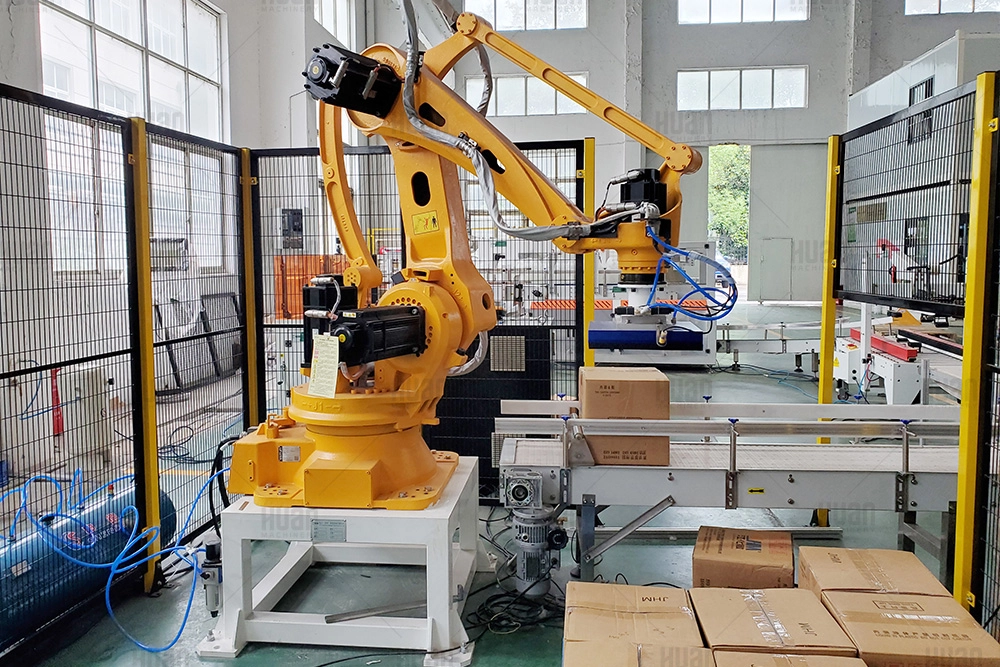
The Robotic Manipulator: The workhorse of the system. For palletizing, robots are typically selected for their reach, payload capacity, and speed. Articulated 4-axis or 6-axis robots (from manufacturers like Fanuc, ABB, KUKA, Yaskawa) are common, with the former offering fast, efficient motion in a limited space for standard stacking patterns. The robot’s payload must account for the weight of the heaviest part plus the weight of the End-of-Arm Tooling (EOAT).
-
End-of-Arm Tooling (EOAT): This is the critical interface and often the most custom-designed component. Unlike a welding torch or machining spindle, an EOAT for palletizing robots must be adaptable, gentle, and reliable. Common types include:
-
Mechanical Grippers: Parallel jaw grippers or angular grippers for securely grasping individual parts by their machined features.
-
Vacuum Tooling: Arrays of suction cups (bellows, flat, or oval) ideal for handling large, flat, or non-porous surfaces like sheet metal or finished plates. Vacuum systems are quiet, fast, and can be easily segmented to handle multiple parts per cycle.
-
Hybrid Tooling: Combines mechanical clamping with vacuum assist or integrates part presence sensors and barcode scanners.
-
-
Infeed System: This is how parts are presented to the robot. It can be a conveyor belt (belt, roller, or chain), a shuttle table, a vibratory feeder bowl (for small parts), or even an automated guided vehicle (AGV) drop-off station. The infeed system’s reliability dictates the entire cell’s uptime.
-
Pallet Handling & Staging: This includes the magazine or conveyor that supplies empty pallets (or totes, crates) to the work area and removes full ones. Advanced systems may include automatic pallet dispensers, stretch wrappers, and label applicators in-line.
-
Vision Guidance System (Often Critical): A 2D or 3D camera system mounted above the infeed conveyor identifies the part’s orientation, selects the optimal pick point, and may also verify part quality or read identification marks. This is essential for handling parts that are presented in a random orientation (mixed or bulk) rather than being precisely fixtured.
-
Safety & Control System: Perimeter fencing, light curtains, or area scanners ensure safe operation. A central PLC coordinates the robot, conveyors, and peripherals, often interfacing with a Warehouse Management System (WMS) for pallet tracking.
1.2 Palletizing Patterns and Software Intelligence
The intelligence of a palletizing robot lies in its software. Offline programming and simulation tools allow engineers to design stable, dense pallet patterns (layer patterns) that maximize space utilization and ensure load stability during transport. The software automatically generates the robot’s path to build these patterns layer by layer, accounting for gripper clearances and optimizing the motion sequence to minimize cycle time. For mixed-SKU pallets, the software can dynamically adjust the pattern based on which part arrives at the pick station.
Table 1: Comparison of Palletizing Robot Technologies for Different CNC Part Profiles
Part Characteristic Recommended Robot Type Recommended EOAT Key Software Feature Rationale & Consideration Heavy, Large Parts (e.g., Engine Blocks, Large Castings) High-payload (>150kg) 6-axis robot. Custom mechanical gripper with form-fit jaws; hydraulic actuation possible. Low-speed, high-stability path planning; weight distribution calculation. Requires immense grip force and robot stiffness; safety is paramount; pattern density is usually low. Small, Delicate Parts (e.g., Medical Implants, Aerospace Brackets) Medium-payload collaborative robot (cobot) or fast 6-axis robot. Soft-touch mechanical gripper (silicone jaws) or micro-vacuum cups. Precise force control; gentle acceleration profiles; vision for precise pick. Must prevent surface marring; cobots allow for safe human-robot collaboration in flexible cells. Mixed SKUs / Random Orientation (e.g., Machined Fittings, Fasteners) 6-axis robot with high dexterity. General-purpose 2-finger gripper or magnetic gripper (for steel). Advanced 3D vision guidance; AI-based recognition and sorting logic. The vision system is the brain; robot must be able to pick parts from any angle; programming complexity is high. High-Volume, Identical Parts (e.g., Automotive Pistons, Connectors) High-speed 4-axis (SCARA) or delta robot. Multi-head vacuum tool or mechanical gripper array (to pick multiple parts per cycle). Ultra-optimized, repetitive path planning; synchronization with high-speed conveyors. Speed is the primary driver; tooling is often custom-designed to handle a family of similar parts. Flat Sheets or Plates (e.g., Machined Blanks, Cover Plates) Gantry-style Cartesian robot or long-reach 6-axis. Large-frame vacuum lifter with multiple zones. Simple layer pattern algorithms; zone control to handle different sheet sizes. Requires large work envelope; vacuum is ideal for non-marking handling; Cartesian robots offer excellent positional accuracy over large areas.
Section 2: The Integration Blueprint – Deploying Palletizing Robots in a CNC Workshop
Implementing palletizing robots requires a systematic approach that considers both the physical workflow and digital information flow.
Phase 1: Workflow Analysis and Cell Design
-
Part Analysis: Document every part that will be palletized: dimensions, weight, surface finish, fragility, and any existing features suitable for gripping (e.g., through-holes, bosses, smooth datum faces).
-
Throughput Calculation: Determine the required cycles per hour. This is a function of part cycle time from the CNC machine, batch sizes, and shift patterns. This dictates the required speed of the palletizing robot.
-
Layout Planning: Design the cell footprint. This includes the robot’s reach envelope, the infeed conveyor length (which acts as a buffer), the staging area for full/empty pallets, and maintenance access. In crowded workshops, a compact footprint is often critical.
-
Pallet and Packaging Specification: Standardize on pallet sizes (euro, standard) and packaging materials (corrugated dividers, foam inserts). The robot’s program and tooling are designed around these standards. For delicate CNC machined components, custom foam nesting trays, which can be precisely machined by JLYPT’s capabilities, provide the ultimate protection and facilitate robotic placement.
Phase 2: The Critical Role of End-of-Arm Tooling (EOAT) Engineering
The EOAT is where the robot connects with the part. Its design is paramount.
-
Gripper Selection: Based on Table 1. For machined parts, mechanical grippers often locate on non-critical, robust features. Vacuum is excellent for finished surfaces but requires a clean, non-porous area.
-
Custom Jaw Design: Jaws are frequently custom-machined from aluminum, Delrin, or urethane to match the part geometry, distributing grip force and preventing damage. The ability to rapidly machine these custom jaws in-house, as JLYPT does for its own tooling needs, is a significant advantage.
-
Tool Changers: For shops handling a wide variety of parts, an automatic tool changer on the robot wrist allows one robot to service multiple infeed lines by switching between different dedicated EOATs in seconds, guided by the production schedule.
H2: Phase 3: Control System and Data Integration
The palletizing robot should not be an information island.
-
Integration with MES/WMS: Upon completing a pallet, the robot controller should send a digital signal to the Manufacturing Execution System (MES) containing: Pallet ID, Part Number, Quantity, Timestamp. This automatically updates inventory and triggers logistics.
-
Machine Connectivity: In an ideal setup, the final CNC machine or washing station signals the palletizing cell that a batch of parts is ready, initiating the automated flow.
-
Vision System Data: The camera can be used for more than guidance; it can perform basic quality checks (presence of all features, severe damage) and log serial numbers, feeding data back into the quality management system.
Section 3: The Business Case – Quantifying the Impact of Palletizing Robots
The investment in palletizing robots is justified by a combination of hard cost savings and soft, strategic benefits.
Direct Labor and Productivity Gains
The most immediate saving is the reallocation of labor from repetitive, physically taxing stacking to higher-value roles like machine tending, quality inspection, or programming. A single palletizing robot can typically replace 1-2 full-time equivalents on a shift, with consistent performance 24/7. It eliminates slowdowns due to fatigue and breaks, maintaining a steady, predictable output rate that can become the new baseline for production planning.
Error Reduction and Damage Prevention
Manual palletizing is prone to errors: incorrect counts, wrong parts mixed in, and unstable stacking leading to toppled loads and damaged goods. Palletizing robots, when properly programmed and equipped with sensors, eliminate these errors. Every pick and place is verified. Every layer pattern is mathematically stable. This dramatically reduces costly returns, warranty claims, and internal scrap due to handling damage, a critical factor for high-value aerospace or medical components.
Space Optimization and Traceability
Robots can build denser, more uniform pallets than humans, optimizing trailer space and reducing shipping costs. Digitally, each pallet becomes a tracked asset. When a pallet ID is scanned in shipping or at the customer’s facility, its complete digital history, including the machine that made each part and the time it was palletized, is available. This level of traceability is a competitive advantage in regulated industries.
Table 2: ROI Analysis Framework for Implementing Palletizing Robots in a CNC Shop
Cost/Benefit Category Manual Palletizing Robotic Palletizing Quantitative Impact & Calculation Example Direct Labor Cost $50,000 – $100,000 per year (1-2 FTEs, including benefits). $5,000 – $15,000 per year (maintenance, programming support). Annual Savings: $35,000 – $95,000. Straight reduction in payroll expense. Productivity (Pieces/Hr) Variable, slows over shift. Avg: 200 parts/hr. Consistent, no fatigue. Avg: 350 parts/hr. Throughput Increase: 75%. Enables handling higher volumes without adding labor. Product Damage Rate 0.5% – 2% (depending on part fragility). <0.1% (controlled grip, perfect placement). Annual Scrap Savings: (Value of 1.4% of annual production). For $5M output, saves $70,000. Shipping Optimization Sub-optimal pallet density, manual errors in load planning. Maximized density, perfect stacking, digital manifest. Estimated Freight Cost Reduction: 5-15%. Saves thousands annually on high-volume shipments. Initial Capital Outlay Minimal (gloves, carts). High ($75,000 – $200,000 for robot, EOAT, cell integration). Primary investment hurdle. Payback period typically 1.5 – 3 years. Operational Flexibility High (human adaptability). Programmable. Changeover requires new program/jaws (30min – 2hrs). Initial setup time for new parts is key. Offline programming minimizes downtime. Traceability & Data Paper-based, error-prone. Fully digital, automatic logging to MES. Reduces quality escapes, supports certifications (ISO, AS9100), improves customer trust.
Section 4: Case Studies – Palletizing Robots in Action Across Industries
Case Study 1: Automotive Tier-1 Supplier – Transmission Gear Palletizing
-
Challenge: A manufacturer of precision transmission gears faced a bottleneck in their finishing department. Gears exiting the CNC gear hobber and washer had to be manually placed into partitioned shipping totes. The process was slow, led to occasional mixing of part numbers, and caused cosmetic nicks on critical surfaces.
-
Solution: Integration of a high-speed 6-axis palletizing robot with a dual-gripper EOAT. One side had a mechanical centering gripper to pick the gear by its bore, the other had a vacuum cup to pick and place the plastic divider sheet. A vision system verified the gear’s tooth count before picking. The robot built layered patterns in standardized returnable containers.
-
Outcome: Throughput increased by 120%. Damage due to handling was eliminated. The system automatically sorted and palletized 15 different gear SKUs running in mixed batches, with 100% accuracy verified by the vision system. The labor of two operators was re-deployed to upstream processes.
Case Study 2: Job Shop Machining – High-Mix, Low-Volume Flexible Cell
-
Challenge: A contract machining shop serving the aerospace and defense sectors produced hundreds of different parts in small batches. Manual palletizing for shipment was chaotic, time-consuming, and made kitting for assemblies prone to errors.
-
Solution: Deployment of a collaborative robot (cobot) palletizing robot on a mobile cart. The cobot was equipped with a general-purpose electric gripper and a 2D vision system. For each new job, the operator would wheel the cart to the delivery point, load the empty shipping box, and initiate the program. The vision system would identify the parts on the table, and the cobot would pick and place them in the specified pattern.
-
Outcome: While not as fast as a dedicated cell, the system eliminated the ergonomic strain of repetitive bending and lifting. It ensured the correct count and arrangement for every shipment, improving customer satisfaction. The flexibility and ease of programming of the cobot made it viable for a high-mix environment where a traditional system’s ROI would be hard to justify.
Case Study 3: High-Volume Consumer Electronics – Aluminum Enclosure Final Packaging
-
Challenge: A manufacturer of premium wireless speakers required the final palletizing of CNC-machined aluminum enclosures into retail-ready boxes with high cosmetic standards. The manual process was a major cost center and the leading cause of minor scratches requiring rework.
-
Solution: A fully automated line featuring two delta palletizing robots. The first robot, equipped with a soft silicone suction cup, picked enclosures from a padded conveyor and placed them into foam nests inside the retail box. A second robot then picked the filled boxes and placed them in a shipping case pattern on a pallet. All contact surfaces were soft or compliant.
-
Outcome: The line achieved a throughput of over 60 units per minute. Cosmetic defect rates related to packaging dropped by over 99.5%. The entire packaging line ran with two monitoring technicians instead of a team of 12 manual packers, yielding a payback period of under 14 months on the robotic investment.
Conclusion: Sealing the Loop on Automated Value Delivery
The integration of palletizing robots represents the final, critical step in creating a truly continuous and digital manufacturing flow. For CNC machining operations, it addresses the last major domain of manual, variable, and costly labor, ensuring that the precision and care invested in machining are preserved all the way to the customer’s receiving dock. The benefits extend far beyond labor displacement, encompassing dramatic improvements in quality consistency, asset traceability, space utilization, and operational data.
Implementing such a system requires careful analysis of the product mix, thoughtful engineering of the gripper interface, and smooth integration into the broader production IT field. The result, however, is a resilient, scalable, and predictable logistics operation that complements the high-tech nature of modern CNC machining.
For manufacturers looking to improve their entire operation from raw material to shipped product, the journey involves looking downstream. At JLYPT, our experience in precision manufacturing gives us unique insight into the handling requirements of delicate, high-value components, informing effective automation strategies for our clients.
Ready to explore how palletizing robots can complete your automated workflow and protect your quality to the very last step? Contact JLYPT to discuss your post-machining logistics challenges. Learn about our end-to-end manufacturing philosophy at JLYPT CNC Machining Services.