Navigating the 2025 Robotics Safety Standards: A CNC Integrator’s Imperative for Safe Automation
The integration of industrial robots into CNC machining cells is no longer a luxury but a cornerstone of modern, competitive manufacturing. As robots transition from isolated work cells to collaborative partners in complex, high-precision tasks, ensuring operational safety transcends regulatory compliance—it becomes a fundamental engineering and ethical responsibility. The recent, landmark update to the global benchmark for robotic safety, ISO 10218:2025, marks a pivotal shift. For system integrators and precision manufacturers like JLYPT, mastering these evolved robotics safety standards is critical to deploying automation that is not only highly productive but also inherently safe, future-proof, and aligned with the latest technological paradigms like Industry 4.0 and collaborative robotics.
This comprehensive guide delves into the intricacies of the updated robotics safety standards, with a sharp focus on their practical application within CNC machining environments. We will decode the key changes, translate them into actionable integration strategies, and demonstrate through detailed case studies how a safety-first approach underpins successful, reliable, and innovative automation solutions.
The Bedrock of Safety: Understanding ISO 10218-1 & -2:2025
The ISO 10218 series is globally recognized as the paramount safety standard for industrial robots. It is structured into two complementary parts:
-
ISO 10218-1: Safety requirements for industrial robots: Focuses on the robot as an incomplete machine, outlining the manufacturer’s responsibilities for its inherent safe design.
-
ISO 10218-2: Safety requirements for industrial robot applications and robot cells: Provides the crucial framework for system integrators (like JLYPT), covering the safe integration, installation, and operation of the complete robotic work cell.
Published in February 2025, these revisions are the first major updates since 2011, reflecting over eight years of expert consensus to address technological advancements.
Key Drivers for the 2025 Revision
The update was necessitated by several transformative trends in automation:
-
The Rise of Collaborative Robotics (Cobots): The need to safely standardize human-robot interaction (HRI) beyond separate technical specifications.
-
Increased System Complexity: Integration of robots with mobile platforms (AGVs), advanced sensors, and complex CNC machinery demands clearer guidelines.
-
Cybersecurity Threats: As robots become networked data nodes, digital security is now recognized as an integral component of functional safety.
-
Demand for Clarity and Flexibility: Industry required less ambiguous, more risk-based approaches to functional safety compliance.
Decoding the Major Changes: From Prescriptive to Risk-Based
The 2025 revisions introduce profound changes, significantly expanding the scope and detail of the standards. The page count alone signals a deeper, more comprehensive approach: Part 1 grew from 50 to 95 pages, and Part 2 expanded dramatically from 72 to 223 pages.
Table 1: Core Updates in ISO 10218:2025 Affecting CNC Machining Integration
| Aspect | ISO 10218:2011 (Previous) | ISO 10218:2025 (New) | Impact on CNC Robotic Cells |
|---|---|---|---|
| Collaborative Operations | Guided by separate technical specification (ISO/TS 15066). | Requirements for collaborative applications are fully incorporated into the main standard. | Enables seamless design of cells where operators and robots share workspace for tasks like part inspection, manual loading, or tool setting. |
| Functional Safety Requirements | Often prescriptive (e.g., uniform requirement for PL d / Category 3). | Risk-based, application-specific Performance Level (PL) determination is emphasized. Introduces robot classification (Class I vs. Class II) with differing safety requirements. | Allows for more optimized and cost-effective safety system design. A Class I robot (lower force/speed) in a deburring cell may require a lower PL than a Class II robot handling heavy raw billets. |
| Robot Classification | Not explicitly defined. | Introduces Class I (limited force & speed) and Class II (all other robots) with distinct safety function mandates. | Critical for integrators to select the correct robot class for the application’s hazard potential and design safety controls accordingly. |
| Cybersecurity | Not addressed. | Explicit cybersecurity requirements are added, recognizing networked robots as potential safety targets. | Mandates secure communication protocols and access controls for robot controllers connected to factory networks or cloud-based monitoring systems. |
| Scope of Application | Focused on static robot cells. | Explicitly includes robots mounted on mobile platforms (e.g., AGVs), while clarifying that mobility safety is covered by other standards. | Supports the design of flexible, mobile machining units that can service multiple CNC stations, expanding automation possibilities. |
Applying the Standards: A Safety Integration Framework for CNC Cells
For an integrator, compliance is a process, not a checkpoint. Here is a systematic framework aligned with ISO 10218-2:2025.
Phase 1: Comprehensive Risk Assessment & Hazard Analysis
Every integrated cell must begin with a formal risk assessment per ISO 12100. In a CNC context, this goes beyond the robot to include:
-
Mechanical Hazards: Crushing and impact points at the robot arm, gripper, and automated doors of the CNC machine. Entanglement with rotating spindles or pallet changers.
-
Process-Related Hazards: Exposure to cutting fluids, airborne particulates from machining, sharp edges on workpieces, and high-energy processes like laser marking or welding integrated into the cell.
-
Electrical & Control Hazards: Failures in safety-rated monitored stop (SRMS) circuits, unintended movements due to electromagnetic interference, or software errors.
Phase 2: Implementing Hierarchical Protective Measures
The standard mandates a hierarchy of controls. For a CNC robotic cell, this typically involves:
-
Inherently Safe Design by Construction: Selecting a Class I collaborative robot for tasks requiring frequent human intervention, such as fine polishing or delicate assembly adjacent to a CNC lathe.
-
Technical Safeguarding: Implementing fixed perimeter guarding with interlocked safety gates for high-speed, high-payload material handling cells. Using safety-rated light curtains or laser scanners to create protective zones that halt the robot if an operator breaches the space during automatic operation.
-
Functional Safety of Control Systems: Designing the safety-related control system (SRP/CS) to achieve the Performance Level (PL) determined by the risk assessment. This involves using safety PLCs, safe torque off (STO) circuits on robot and spindle drives, and validated safety functions like speed and separation monitoring (SSM) in collaborative zones.
-
Information for Use: Providing clear documentation, safety signage (pictograms per ISO 7010), and comprehensive training for operators and maintenance personnel on procedures like lockout-tagout (LOTO) for cell entry.
Phase 3: Validation, Documentation, and Lifecycle Management
The 2025 standards emphasize rigorous validation and traceability. This includes:
-
Simulation and Testing: Using offline programming (OLP) software to simulate robot paths and verify reachability and cycle times while checking for potential collisions in a virtual environment before physical commissioning.
-
Functional Safety Verification: Testing all safety functions (e.g., emergency stops, gate interlocks, safe speed limits) to verify they meet the required PL.
-
As-Built Documentation: Delivering a complete technical file, including the risk assessment report, safety circuit diagrams, validation records, and maintenance manuals—a requirement reinforced for compliance with evolving regulations like the EU Machinery Regulation 2023/1230.
Case Studies: Safety Standards in Action at JLYPT
Case Study 1: Safe Collaborative Deburring and Inspection Cell
-
Challenge: A medical device manufacturer required post-machining deburring and 100% inspection of small, complex titanium implants. Manual work was slow and variable, but a fully isolated cell would hinder flexibility.
-
JLYPT Solution: We designed a cell featuring a Class I collaborative robot (Cobot) equipped with a force-torque sensor for adaptive deburring. The cell applied the integrated collaborative operation principles from ISO 10218:2025.
-
Safety Integration:
-
Power and Force Limiting (PFL): The cobot’s intrinsic PFL capabilities were validated to stay within biomechanical limits.
-
Speed and Separation Monitoring (SSM): A safety laser scanner defined warning and stop zones around the cell. The robot speed reduced as an operator approached and stopped if the minimum separation distance was breached.
-
Hand-Guiding Mode: For quick teach-in of new part geometries, the operator used the robot’s certified hand-guided programming mode.
-
-
Outcome: The cell eliminated the ergonomic hazards of manual deburring, maintained a seamless workflow with operator oversight, and provided full documentation for FDA audit trails.
Case Study 2: High-Volume Machining Cell with Multi-Robot Material Handling
-
Challenge: An automotive supplier needed to machine aluminum transmission housings across three CNC horizontal machining centers (HMCs) with minimal human intervention for lights-out production.
-
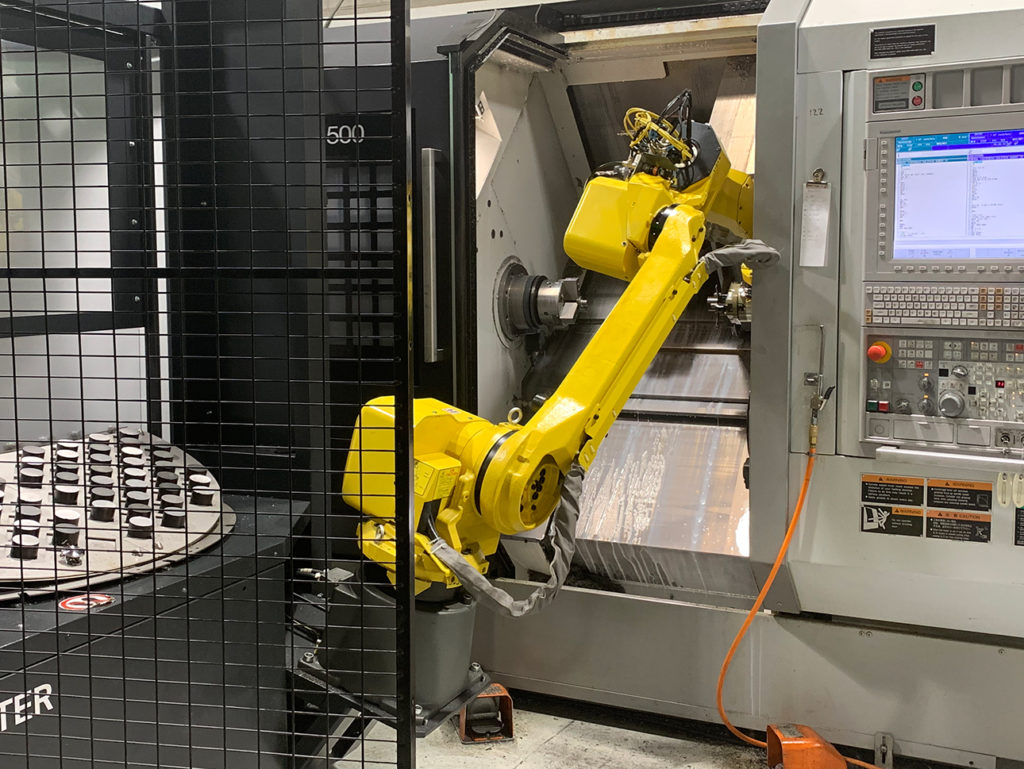
JLYPT Solution: We engineered a fully automated cell with two Class II industrial robots on linear tracks servicing the HMCs, linked by a centralized pallet storage system.
-
Safety Integration:
-
Fixed Guarding & Access Control: The entire cell was enclosed with steel mesh fencing. Access to the interior for maintenance required a key-exchange system that triggered a safe stop of all robots and CNCs.
-
Safety-Integrated Logic: The system used a safety PLC to orchestrate movements. A “safeguarded space” logic ensured Robot A could only enter the working envelope of HMC 1 when its door was confirmed open and HMC 1’s spindle was at a safe home position.
-
Cybersecurity Measures: The robot and CNC controllers were placed on a segmented, firewalled network with role-based access control to prevent unauthorized programming changes, addressing the new cybersecurity clause.
-
-
Outcome: The cell achieved 24/7 production with zero personnel inside during automatic operation, maximizing productivity while adhering to the highest Category 3, PL d safety level for its hazardous movements.
Case Study 3: Flexible Mobile Robot Platform for Multi-Station Machining
-
Challenge: A job shop machining large, low-volume aerospace components needed flexibility to move parts between disparate stations: a 5-axis mill, a CMM, and a wash station.
-
JLYPT Solution: We implemented an Autonomous Mobile Robot (AGV) with an integrated collaborative robot arm, creating a mobile machining assistant.
-
Safety Integration:
-
Dual-Standard Compliance: The solution complied with both ISO 10218-2:2025 for the robotic application and ISO 3691-4 for the safety of driverless industrial trucks.
-
Dynamic Risk Assessment: The mobile unit’s navigation system used onboard LiDAR and 3D cameras for dynamic path planning and person detection. When stationary and performing a task (e.g., unloading a part), it functioned as a fixed collaborative cell under ISO 10218.
-
Clear Procedural Controls: Work instructions mandated that the CNC machine door must be open and the machine in a safe state before the mobile platform could dock and initiate part transfer.
-
-
Outcome: The shop gained tremendous flexibility without fixed, floor-space-intensive automation. The clear safety protocols ensured safe interaction between the mobile unit, stationary equipment, and shop floor personnel.
Beyond Compliance: The Strategic Value of Proactive Safety Leadership
Adhering to robotics safety standards like ISO 10218:2025 is the foundation, but leading manufacturers view safety as a strategic catalyst.
-
Enabler of Innovation: A robust safety framework allows for the confident adoption of advanced applications like human-robot collaboration, which can unlock new levels of agility and efficiency.
-
Reduced Total Cost of Ownership: Preventing accidents avoids catastrophic downtime, liability, and damage to capital equipment. Proactive safety design often identifies and eliminates process inefficiencies.
-
Market Access and Trust: Compliance is a prerequisite for selling machinery in key markets like the EU, North America (ANSI/RIA R15.06/CSA Z434), and Asia. Demonstrating safety leadership builds deep trust with clients, especially in regulated industries like aerospace and medical.
-
Future-Proofing: The 2025 standards are designed to accommodate future technologies. By building your integration philosophy on them today, you prepare your operations for tomorrow’s advancements.
Conclusion: Your Partner in Safe, Precision Automation
The updated robotics safety standards represent a significant step forward for the industry. They provide a more nuanced, comprehensive, and risk-based roadmap for integrating robots into complex manufacturing environments like CNC machining. Navigating this landscape requires a partner with deep technical expertise in both precision engineering and functional safety integration.
At JLYPT, we engineer productivity with an unwavering commitment to safety. Our team doesn’t just integrate robots; we design complete cyber-physical systems where precision machining and advanced automation converge within a framework of guaranteed safety and compliance. From the initial risk assessment to final validation and documentation, we ensure your automated cell is powerful, productive, and protected.
Ready to build your next automated machining solution on a foundation of the latest safety standards? Contact our automation engineering team today to discuss a safety-focused approach to your productivity challenges.