
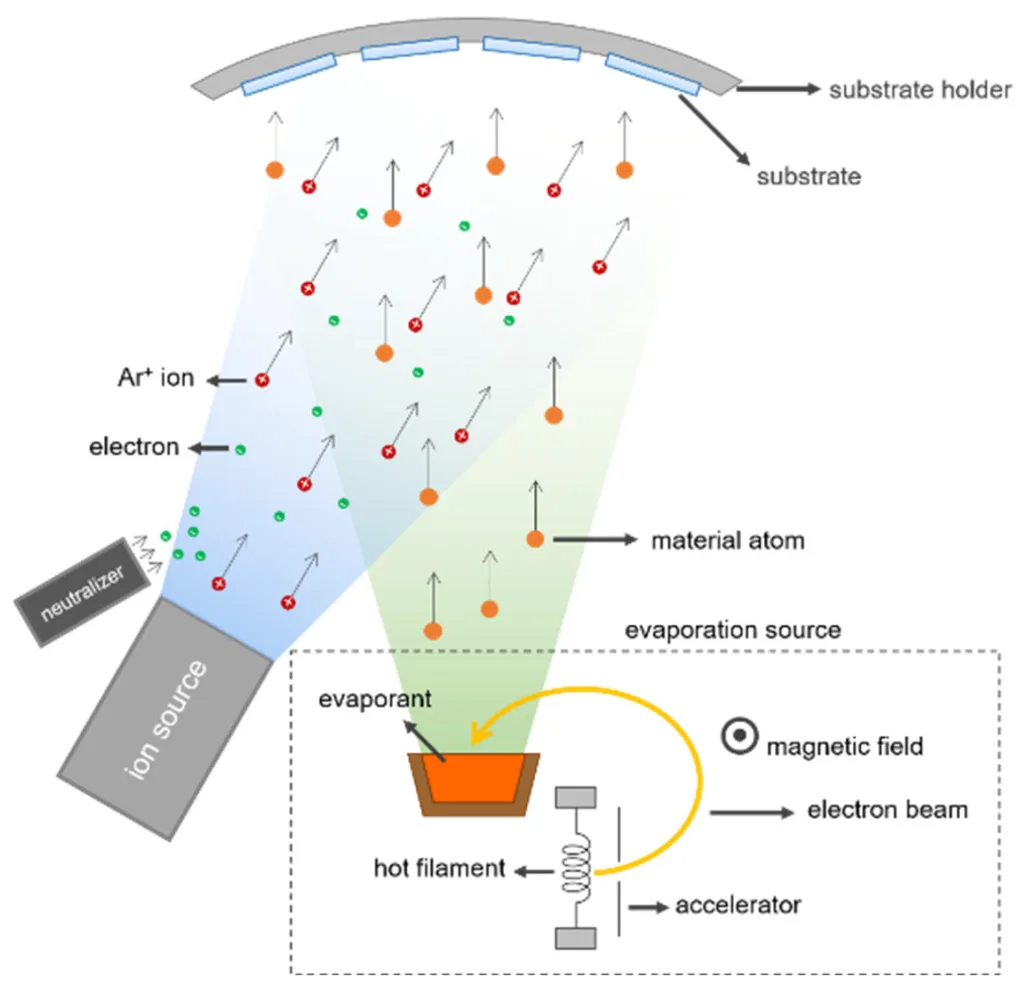
Electron Beam PVD Explained: High-Flux Nano-Finishing for Extreme Environments
1. What Is Electron Beam PVD?
| Metric | Electron Beam PVD | Magnetron Sputter | Electroplated Ni |
|---|---|---|---|
| Thickness Range | 5 nm–5 µm | 1–5 µm | 5–50 µm |
| Deposition Rate | 5–50 µm/h | 0.5–2 µm/h | 5–20 µm/h |
| Hardness (HV) | 2 800–3 500 | 2 500–3 200 | 700 |
| Max Service Temp | 1 000 °C | 400 °C | 300 °C |
| REACH Status | ✅ Compliant | Compliant | ⚠️ Restricted |
2. The 6-Step e-Beam Process – From Cathode to Coating
| Step | Vacuum Level | Temp (°C) | Action | KPI |
|---|---|---|---|---|
| 1 Plasma Clean | 10⁻³ mbar | 25 | Ar⁺ removes oxide & oil | Contact angle ≤ 8° |
| 2 Pre-heat | 10⁻³ mbar | 150–500 | Substrate heating | ΔT ≤ 5 °C |
| 3 E-Beam Ignition | 10⁻⁴ mbar | 1 500–2 500 | Tungsten filament → electron beam | Beam current 0.5–5 A |
| 4 Evaporation | 10⁻⁴ mbar | 1 500–2 500 | Solid ingot → vapor cloud | Evaporation rate 1–10 g/min |
| 5 Dense Film Growth | 10⁻⁴ mbar | 150–800 | Vapor condenses on substrate | ±3 nm uniformity |
| 6 QA & Pack | Air | 25 | CT + nano-indent + salt-spray | CpK ≥ 1.67 |
3. 2024 Performance Matrix – e-Beam vs Other PVD Routes
| Method | Thickness (µm) | Hardness (HV) | Salt-Spray (h) | Max Temp (°C) | Typical Use |
|---|---|---|---|---|---|
| Electroplated Ni | 25 | 700 | 48 | 300 | Decorative trim |
| Spray Paint | 50 | 200 | 48 | 150 | Body panels |
| Filtered Arc ta-C | 0.5 | 3 000 | 1 000 | 400 | Medical drills |
| HiPIMS Sputter | 1 | 3 200 | 1 200 | 1 000 | EV motor punches |
| Electron Beam PVD | 2 | 3 500 | 1 200 | 1 000 | Turbine blades |
4. Three 2024 Case Studies
Case 1 – Aerospace Turbine Blade
-
Client: European OEM, 2024
-
Problem: Fretting at 850 °C dovetail
-
e-Beam Stack: TiAlCrN 2 µm + a-C:H 200 nm
-
Outcome: Wear scar < 5 µm after 1 000 h; maintenance interval doubled
Case 2 – EV Motor Lamination Die
-
Client: US EV Tier-1, 2024
-
Problem: 0.35 mm electrical steel sticking at 400 °C
-
e-Beam Stack: CrAlON 1.8 µm + a-C:H 50 nm
-
Outcome: Tool life 4× longer, scrap −40 %
Case 3 – Medical Drill
-
Client: US MedTech startup, 2024
-
Problem: 316L needs low-friction piercing
-
e-Beam Stack: ta-C 300 nm + Cr 30 nm adhesion
-
Outcome: Penetration force −25 %, CE mark granted
5. Global Standards & Sustainability
-
ISO 9001:2015 / IATF 16949 / ISO 13485
-
REACH, RoHS, FDA 21 CFR §175.300
-
Energy: 0.35 kWh per m² (e-beam)
-
Waste: Zero liquid effluent
6. 7-Day Delivery Timeline
| Milestone | Lead Time |
|---|---|
| DFM + Quote | 24 h |
| Prototype (1–10 pcs) | 48 h |
| Validation (CT, salt-spray) | 5 days |
| Mass Production | 7–10 days |
| Door-to-Door Delivery | 12 days total |
7. FAQs – Which e-Beam Stack Fits My Job?
| Question | Answer |
|---|---|
| Can e-beam coat plastics? | Yes, metallised PEEK, LCP. |
| Largest part? | 800 mm Ø × 1200 mm L. |
| Minimum order? | 1 piece. |
8. How to Start Tomorrow
-
Email [email protected] with STEP/IGES.
-
Specify substrate, load, temperature, thickness budget.
-
Receive DFM + e-beam stack + quote within 48 h.
-
Approve → 3-day prototype → volume ramp.
Explore complementary services: Professional Anodizing Near Me
Further Reading
The following guides take this topic further:
- Types of PVD Coatings Explained
- What Is PVD Coating? Guide for Engineers
- High-Temperature Wear-Resistant Coatings
Ready to master electron beam PVD? Contact JLY Precision Tech, the China expert who explains the process and delivers tomorrow.