MIL-C-5541 vs MIL-DTL-5541: Mapping an Old Callout to the Current Specification
Still working from a print that says MIL-C-5541 Class 3? The coating itself is produced every week, so nothing has to stop. But that callout cites a document replaced in 2001, and the replacement asks a question the old print never answered: hexavalent or trivalent chemistry. Send the alloy, drawing revision, quantity and the service conditions through the JLYPT quote form and the gap gets checked before metal is cut, which is the cheapest moment to find it.
This guide is written for the people who actually have to deal with the mismatch: design engineers inheriting a print from the nineties, buyers receiving an RFQ with a superseded specification number, quality engineers writing a first article against a callout that no longer exists in the current revision. It covers what changed, what did not, how the old classes map onto the new ones, and where the mapping runs out and someone has to make an engineering decision.
Two designations, one coating, twenty five years apart
MIL-C-5541 was the governing document for chemical conversion coatings on aluminum for most of the second half of the twentieth century. The last revision issued under that number was MIL-C-5541E in 1990. In 2001 the document was reissued as MIL-DTL-5541, part of a broad Department of Defense effort to rewrite older MIL-C, MIL-S and MIL-A documents as detail specifications. The current revision is MIL-DTL-5541F.
Nothing about the physical coating changed at the point of renaming. A part made to MIL-C-5541E Class 3 in 1996 and a part made to MIL-DTL-5541F Class 3 today are expected to meet the same performance intent. What changed is the structure of the document, and the structure is where legacy prints run into trouble, because the newer document introduced a Type designation that did not exist before.
Legacy prints persist for ordinary reasons. CAD templates get copied forward for decades. Customer drawings from aerospace and defense programs are expensive to revise because every change goes through configuration control. Distributor catalogs and internal routing sheets quote the specification number as it appeared on the original release. None of that is unusual, and none of it means the part cannot be built. It means the specification callout needs a second look before quoting.
What actually differs between the two documents
| Item | MIL-C-5541E (1990) | MIL-DTL-5541F (current) |
|---|---|---|
| Document type | Older MIL-C coating specification | Detail specification, performance based |
| Chemistries covered | Hexavalent chromium processes | Type I hexavalent, Type II trivalent |
| Classes in practical use | Class 1A, Class 1B, Class 3 | Class 1A, Class 3 |
| Class 3 contact resistance limit | 5,000 micro-ohms maximum | 5,000 micro-ohms maximum |
| Corrosion test | 168 hours neutral salt spray, ASTM B117 | 168 hours neutral salt spray, ASTM B117 |
| Application methods | Immersion, spray, brush | Immersion, spray, brush, roller |
| Explicit chemistry choice | Not required by the callout | Type must be stated or agreed |
Read that table again and the practical consequence is visible. A print written to the C revision specified a class and left the chemistry to the shop, because there was only one chemistry family to choose from. The current revision makes the chemistry an explicit choice, and a callout that never stated it now has an open field in it.
The type question your 1998 print never answered
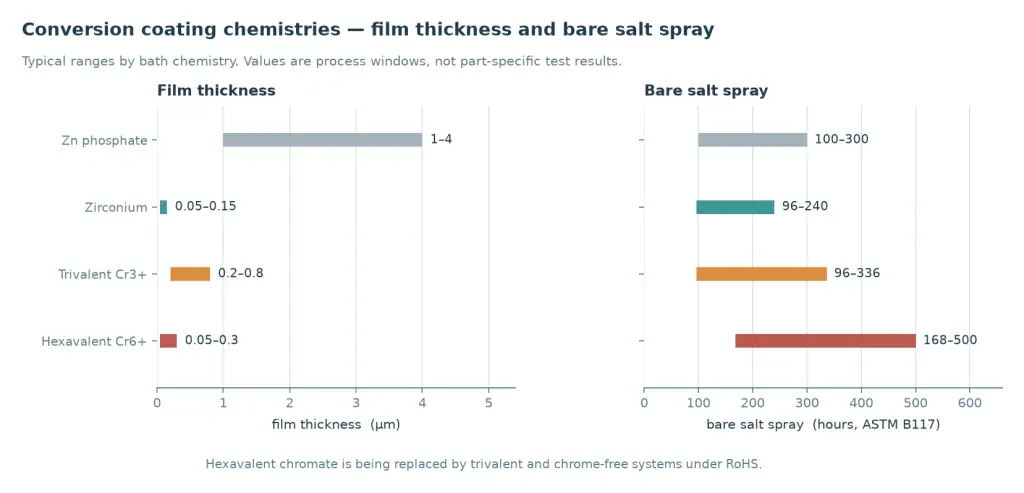
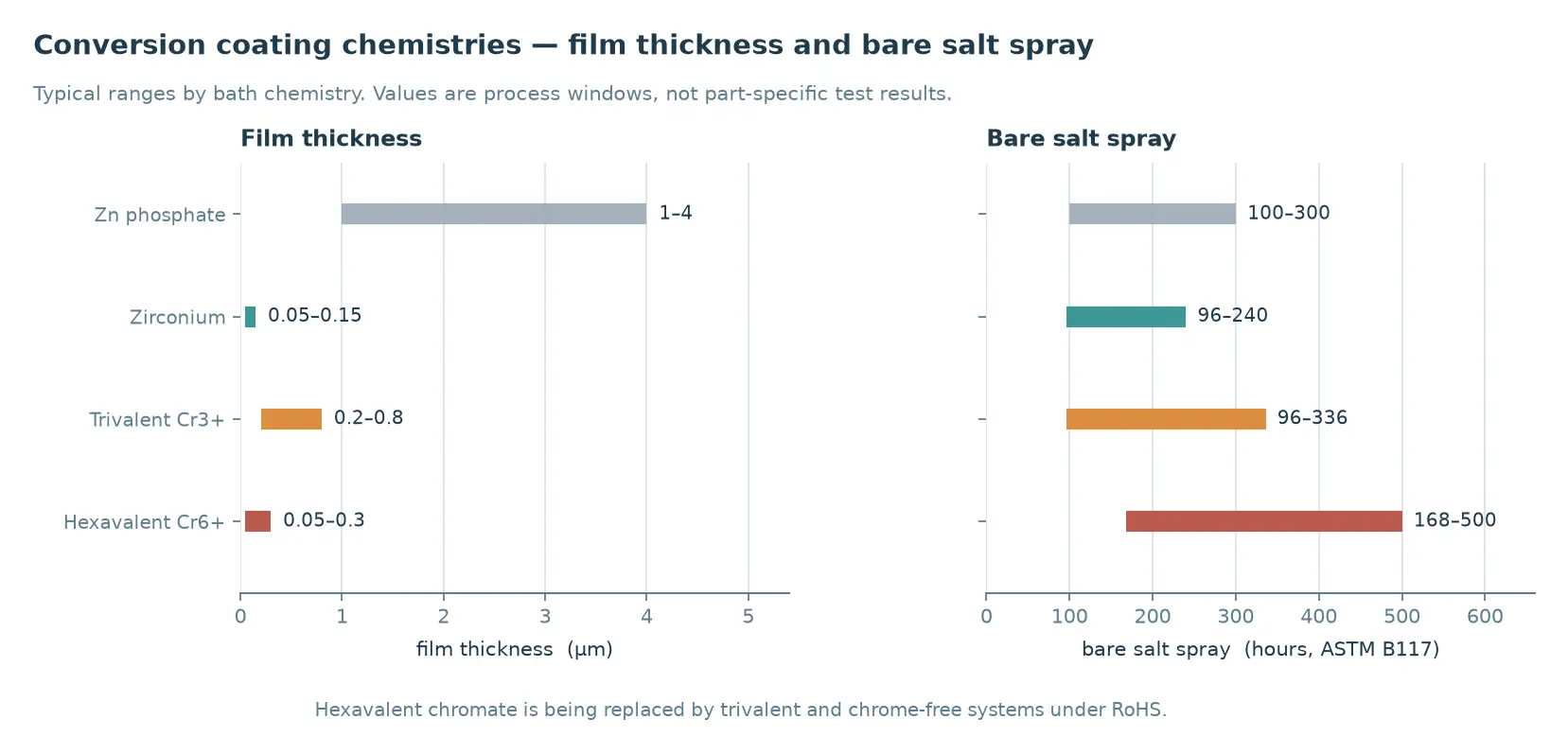
Type I is the hexavalent chromium process. It is the original chemistry, it has the deepest field history, and on bare aluminum it still holds the widest process window for corrosion resistance. Chromate conversion films formed from hexavalent baths also retain the self healing behavior that made the coating famous: a scratched area can repassivate to a degree, which matters on parts that see handling damage before assembly.
Type II is the trivalent chromium process, usually shortened to TCP. It came into the specification because hexavalent chromium is a restricted substance, and customers exporting into the European Union or supplying consumer facing programs increasingly will not accept it. Modern trivalent baths reach the same 168 hour salt spray requirement on common alloys, but the process window is narrower. Bath pH, immersion time, temperature and the fluoride content all matter more than they do on a hexavalent line, and the resulting film is thinner and more sensitive to how clean the incoming surface is.
That difference shows up in manufacturing behavior, not just in chemistry. A shop running Type II needs tighter control of the steps before the coating tank, because there is less margin in the conversion reaction to compensate for a poorly deoxidized surface. The practical answer for a legacy print is therefore a question to engineering rather than a decision to make at the machine: if the drawing is silent on chemistry and the assembly is not exposed to export restrictions or customer substance lists, Type I remains the lower risk route. If any of those restrictions apply, Type II has to be evaluated, and the acceptance criteria should be confirmed before the lot runs.
Mapping the old classes onto the current ones
Class designations survived the transition almost intact, with one exception. The table below is the working mapping used when a legacy callout arrives with an RFQ.
| Legacy callout | Current equivalent | What still needs a decision |
|---|---|---|
| MIL-C-5541 Class 1A | MIL-DTL-5541 Class 1A, Type I or Type II | Chemistry: hexavalent or trivalent |
| MIL-C-5541 Class 1B | No matching class in the current revision | Confirm the original performance intent with engineering |
| MIL-C-5541 Class 3 | MIL-DTL-5541 Class 3, Type I or Type II | Chemistry, plus masking of contact areas |
Class 1B appears on older prints as the maximum protection option with no electrical requirement attached. It has no direct successor in the current revision, and it is rare enough that a supplier seeing it for the first time should not guess. The right move is to ask the drawing owner which performance the part actually needs: if the answer is maximum corrosion protection with no conductivity requirement, an anodic coating may be the more appropriate finish, and that is a different specification entirely.
What Class 3 still requires, unchanged
Class 3 is the conductivity class. It sits at the opposite end of the trade-off from Class 1A: the film is thinner, the corrosion margin is smaller, and the electrical resistance is the property that gets the tightest limit.
- Contact resistance. 5,000 micro-ohms maximum across the coated surface, measured at a defined pressure and contact area. This is the number that separates Class 3 from every other conversion coating class, and it is the one that fails first when the film is too heavy.
- Corrosion resistance. 168 hours of neutral salt spray per ASTM B117 for both types. Class 3 films pass this on the strength of the chromate layer, not on thickness, which is why process control matters more than coating weight here.
- Coating weight. Measured in milligrams per square foot and specified at the low end for Class 3. A heavier film improves salt spray and destroys the electrical requirement, so weight is monitored as an upper bound in practice.
- Adhesion and appearance. The film has to stay on the surface through normal handling and assembly, and it has to be visually uniform, with no bare spots, powdering or free chromate residue.
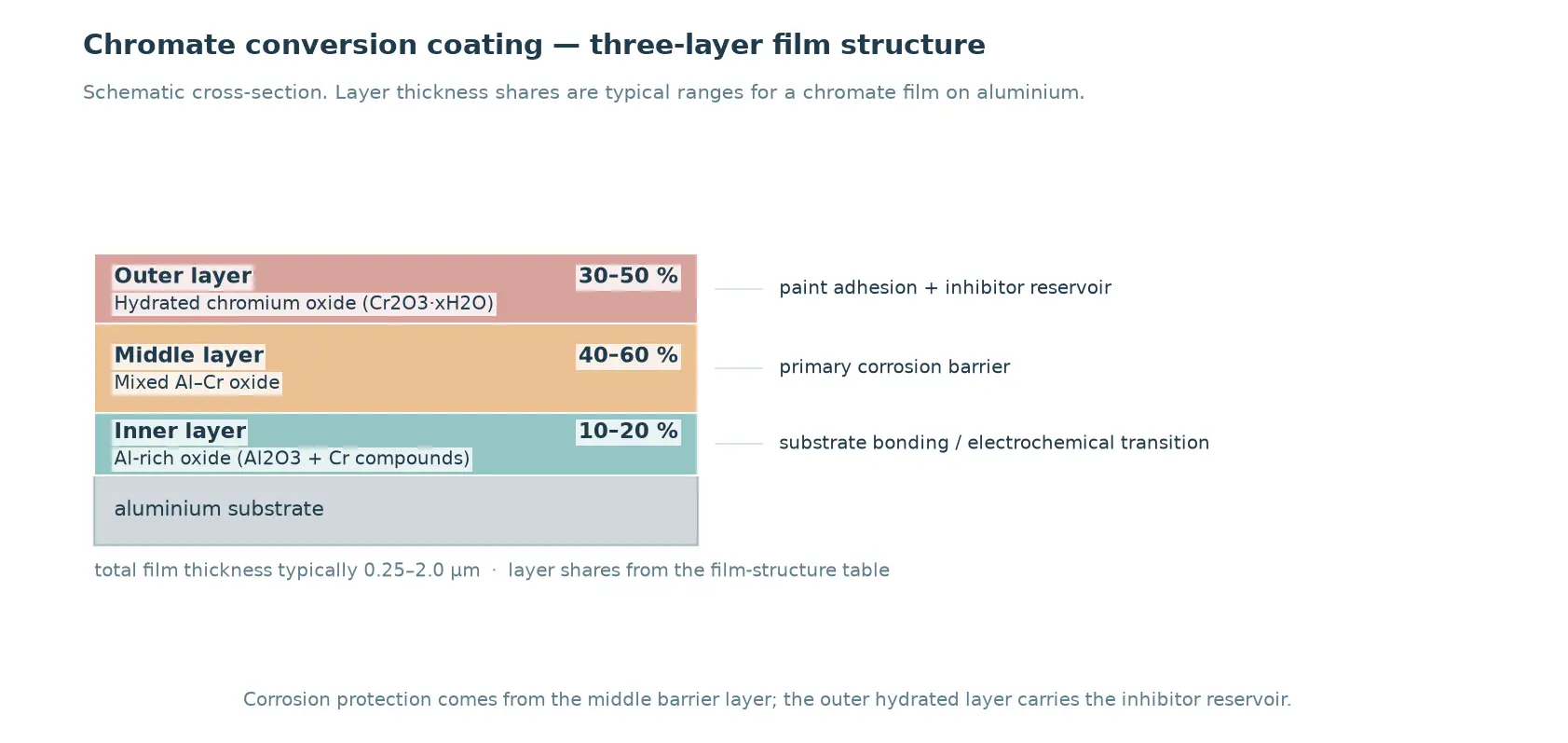
For a deeper treatment of the measured values, alloy behavior and the failure modes specific to Class 3, the MIL-DTL-5541 Class 3 conductive chem film guide covers the current revision in detail. The point here is narrower: those requirements did not change in 2001, so a legacy Class 3 print is asking for the same measured outcome it always asked for.
Where hexavalent chromium is still accepted, and where it is not
This is the part of the old callout with commercial rather than technical consequences, and it is worth stating plainly.
Hexavalent chromium compounds are restricted under the European Union REACH and RoHS frameworks, and hexavalent chromium appears on substance lists maintained by most large OEMs. Defense and aerospace programs frequently operate under exemptions that remain valid, and those exemptions are jurisdiction specific and time limited. A supplier cannot tell a customer whether their program qualifies for an exemption. The customer’s compliance or engineering function has to answer that, and the answer belongs in the RFQ package rather than in a conversation after the parts are coated.
What a finishing shop can do is be clear about which chemistry it is running and what documentation it will provide. If a program requires trivalent because of a substance restriction, that should be stated as a Type II requirement on the purchase order, not left to inference from a MIL-C-5541 callout that never distinguished between chemistries.
Updating a drawing without breaking configuration control
For anyone tempted to simply retype the specification number on a print: don’t. Changing a specification callout on a released drawing is an engineering change, and treating it as a clerical correction is how traceability gets lost. The sequence that works in practice looks like this.
- Confirm the actual requirement with the drawing owner: protection level, conductivity, and any substance restriction. The old class number is a starting point, not an answer.
- Select the current callout, including Type, and record the reasoning in the change note. A reviewer six months later needs to see why the chemistry was chosen.
- Route the change through the normal approval path with the customer, with a first article delta if the program requires it. Salt spray and contact resistance results are usually all that is needed to close the loop.
- Update every downstream document that references the old number: routing sheets, inspection plans, supplier purchase orders, incoming inspection criteria. A drawing changed in isolation creates a mismatch at receiving.
- Keep the legacy callout visible in the drawing history rather than deleting it. Parts already in the field were built to it, and service documentation has to reference it correctly.
Until that change is approved, a supplier should process to the intent of the legacy print and say so explicitly in the quote, the certificate and the inspection plan. Silent substitution of a different class or a different chemistry is not a convenience, it is a nonconformance waiting to be discovered at receiving.
What to send with an RFQ carrying a legacy callout
Quotes on this kind of work are accurate only when the open questions are closed before pricing. The items below are the ones that change cost or lead time.
| Input | Why it changes the quote |
|---|---|
| Alloy and temper | 2xxx and 7xxx series behave differently from 6061, and some lots need longer immersion to reach the same coating weight |
| Drawing revision and the exact callout as printed | Determines whether a type decision is required before the lot releases |
| Type preference, if already decided | Type II runs tighter bath control and may carry different minimum quantities |
| Contact areas and masking requirements | Masking is hand work on small features and is quoted as such |
| Acceptance tests and documentation | Contact resistance and salt spray coupons add cost and lead time, and the test frequency has to be agreed |
| Any substance restriction on the program | Decides whether hexavalent chemistry is available at all |
First article findings that usually trace back to the old callout
These are the recurring issues seen when a legacy print reaches production without the chemistry question being settled first. None of them are mysterious once the cause is known.
- Contact resistance out of limit on a conductivity class. Almost always a film that came out heavier than intended. On thin walled parts or small features, immersion time that suits a large housing over-converts a small one, and the electrical requirement fails while salt spray passes easily.
- Salt spray failure on Type II where Type I passed before. A line converted to trivalent chemistry without re-qualifying the pre-treatment sequence will show scattered pitting that looks random but follows the deoxidize step.
- Cosmetic complaint on dyed or colored films. Color and shade depend on alloy and film weight, and a class change moves both. Expectations set against an older sample cannot be met by a thinner film.
- Documentation rejection at receiving. The certificate references the current revision while the purchase order references the old one. Neither party is wrong, and the part still sits in quarantine until the paperwork matches.
- Masking interference on mating surfaces. Class 3 is often specified precisely because a surface needs to bond electrically, and that requirement is sometimes contradicted by a note elsewhere on the print telling the shop to mask the same area.
Frequently asked questions
Is MIL-C-5541 still a valid specification?
It is superseded. Parts are still produced against its intent every day, because the performance requirements did not change, but a new drawing should reference MIL-DTL-5541 with a Type stated. Where a legacy print is under configuration control and cannot be revised quickly, the quote should record which revision and chemistry are actually being applied.
Can a shop process MIL-C-5541 Class 3 exactly as written?
In practice, the shop processes to the current revision at the same class and notes the substitution. What it cannot do is choose the chemistry for the customer, because that choice has compliance and performance consequences that belong to the drawing owner.
Does Class 3 chem film protect as well as Class 1A?
No. Class 3 is the conductivity class and carries a lighter film. It meets the same 168 hour salt spray requirement, but with less margin, and it is the wrong choice for a part that will see sustained corrosive exposure with no electrical requirement driving the decision.
Which type should a new drawing specify?
Type II if the program is subject to a substance restriction or ships into a market that restricts hexavalent chromium. Type I if the program is exempt, the alloy is difficult, and the widest corrosion margin is the priority. Where both are viable, the deciding factor is usually whether the customer’s compliance function will accept hexavalent chromium at all.
Does the difference matter for machined parts specifically?
It matters in two places: masking and dimensional effect. Conversion coatings are thin enough that dimensions are rarely affected, but masking of contact areas on a machined housing is manual work and is quoted accordingly. Trivalent films are thinner still, which helps on fine features but leaves less margin against a surface that was not properly deoxidized after machining.
Where this fits with the rest of the finish decision
Conversion coating is one branch of a decision tree that starts with what the surface has to do: conduct, resist wear, resist corrosion, or look a particular way. Where the answer is wear or electrical insulation, an anodic coating is the right family and MIL-A-8625 Type II anodize is the usual starting point. Where conductivity and corrosion protection have to coexist, a chromate conversion coating wins, and the comparison between anodize and chromate conversion coating walks through the trade-off with measured numbers.
For machining and finishing in one route, the CNC machining services page covers the process envelope, and the surface finishing page lists the coating options available on the same floor. Where an anodic coating is the answer instead, custom aluminum anodizing services covers the Type II and Type III work.
To settle a legacy callout on a live project, send the drawing, alloy, quantity and the service conditions through the quote form. State the callout exactly as printed and note whether any substance restriction applies. That is enough to come back with a clear answer on chemistry, class and acceptance testing before the first chip is cut.