
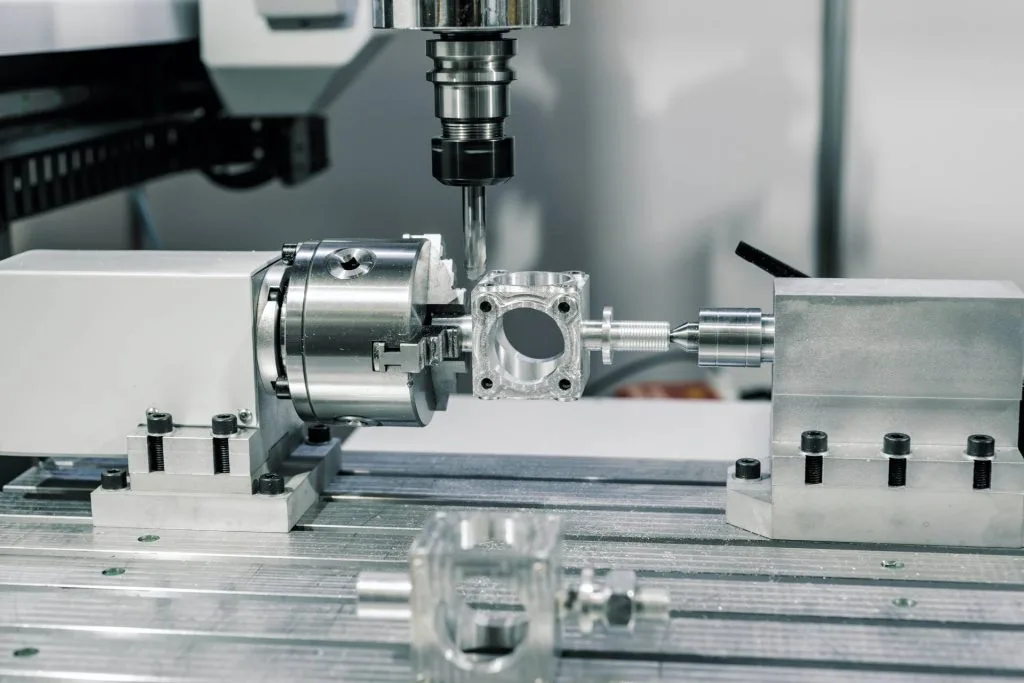
Precision Machined Components for Robotics: Materials and Tolerances
In the rapidly advancing field of robotics, precision machined components form the backbone of innovation and reliability. These components, manufactured through Computer Numerical Control (CNC) machining, enable the complex movements, accurate sensing, and durable performance that modern robotic systems demand. From industrial automation to surgical robots, the quality of these machined parts directly determines the robot’s functionality, accuracy, and longevity.
The Convergence of Precision Machining and Robotic Technology
Robotics represents one of the most demanding applications for precision machining, requiring exceptionally tight tolerances, complex geometries, and specialized material properties. CNC machining services have risen to this challenge by leveraging advanced technologies including 5-axis milling, micron-level accuracy, and high-performance material processing to create components that meet the rigorous standards of robotic applications.
The global industrial robot market, projected to grow from $168.9 billion in 2024 to $294.3 billion by 2029 , demonstrates the expanding need for precision components that can deliver reliable performance in diverse applications from manufacturing to healthcare.
Why Precision Matters in Robotics
Robotic systems depend on precisely manufactured components for several critical functions:
-
Positional Accuracy: Robotic arms require exact positioning to perform tasks consistently. Even minor deviations in component dimensions can result in significant errors at the end effector.
-
Durability: Robotics components must withstand continuous operation often in demanding environments without performance degradation.
-
Repeatability: Manufacturing processes must produce identical components that ensure consistent performance across robotic systems.
-
Minimal Vibration: Precisely balanced components reduce vibration, enabling higher operating speeds and improved accuracy.
-
Energy Efficiency: Accurate components with optimal surface finishes reduce friction and energy consumption.
Key Precision Components in Robotic Systems
Robotic systems incorporate numerous precision machined components, each serving specific functions that collectively enable sophisticated capabilities.
1. Robotic Joint Assemblies
The articulation points in robotic systems require complex combinations of components including harmonic drive systems, bearing housings, and output flanges. These components must maintain precise alignment under dynamic loads and continuous operation.
2. Actuator Housings
Linear and rotary actuators depend on precisely machined housings that maintain alignment of internal components while protecting them from environmental factors. These housings often require internal boring with tolerances within ±0.005mm .
3. End Effector Mechanisms
Robotic grippers and specialized tooling interfaces require components with exacting tolerances to ensure secure workpiece handling and accurate tool positioning. The TMCM1617-GRIP-REF reference design demonstrates how precision machining enables sophisticated gripper functionality with integrated control and grasp detection .
4. Sensor Mounting Brackets
Advanced sensor systems including Time-of-Flight (ToF) sensors, IMUs, and vision systems require stable, precise mounting solutions that maintain calibration under operational stresses. The ADTF3175 ToF sensor, for example, depends on precisely machined mounting interfaces to maintain its calibration for accurate distance measurement and obstacle detection .
5. Drive System Components
Precision gears, leadscrews, and transmission elements form the core of robotic motion systems. These components require specialized machining processes including gear hobbing, thread grinding, and surface hardening to achieve the necessary durability and precision.
6. Structural Elements
Robot frames and linkage systems must provide rigid support while minimizing weight. These components often employ complex internal passages for cable routing and weight-reduction features that require sophisticated 3-axis and 5-axis machining strategies.
CNC Machining Capabilities for Robotic Components
Modern CNC machining services employ advanced technologies to meet the demanding requirements of robotic components:
Table: CNC Machining Capabilities for Robotic Applications
| Machining Process | Tolerance Range | Typical Applications | Special Considerations |
|---|---|---|---|
| 5-Axis Simultaneous Milling | ±0.025mm | Complex structural components, joint assemblies | Enables complex geometries in single setup |
| High-Speed Machining | ±0.015mm | Thin-walled components, aluminum structures | Improved surface finishes, reduced cycle times |
| Micromachining | ±0.0025mm | Miniature components, surgical robot parts | Specialized tooling and machine stability |
| Turn-Mill Centers | ±0.01mm | Rotary components, actuation systems | Complete machining in single setup |
| Precision Grinding | ±0.001mm | Bearing surfaces, shaft journals | Superior surface finishes, tight tolerances |
| Swiss-Type Turning | ±0.005mm | Long, slender shafts, precision pins | Excellent for high-volume small components |
Materials for Robotic Components
Material selection plays a critical role in the performance of robotic components, balancing factors including strength, weight, durability, and machinability.
Table: Materials for Precision Robotic Components
| Material | Properties | Typical Applications | Machining Considerations |
|---|---|---|---|
| Aluminum 6061-T6 | Good strength-to-weight ratio, excellent machinability | Structural components, brackets, housings | Easy to machine, requires thermal management |
| Aluminum 7075-T6 | High strength, good fatigue resistance | High-stress components, joint parts | More challenging to machine, requires rigid setup |
| Stainless Steel 304/316 | Excellent corrosion resistance, good strength | Surgical robots, food processing applications | Work hardening requires appropriate tooling |
| Stainless Steel 17-4 PH | High strength, precipitation hardenable | High-wear components, shafting | Machined in solution-treated condition |
| Titanium Ti-6Al-4V | Excellent strength-to-weight ratio, biocompatibility | Aerospace robotics, surgical instruments | Difficult to machine, requires specialized tools |
| Delrin/Acetal | Low friction, good wear resistance | Bushing, wear plates, isolation components | Easy to machine, requires sharp cutting tools |
| PEEK | High strength, thermal stability, chemical resistance | High-performance applications, medical devices | Requires precise temperature control |
| Brass | Good machinability, electrical conductivity | Electrical components, decorative elements | Excellent machinability, good surface finish |
Advanced Machining Techniques for Robotics
1. Multi-Axis CNC Machining
5-axis simultaneous machining enables the production of complex geometries required for modern robotic systems. This capability allows for complete machining of complex components in a single setup, reducing cumulative errors and improving overall accuracy .
2. Micron-Level Precision
Advanced CNC systems equipped with high-resolution feedback systems can achieve positioning accuracy within ±1 micron. This level of precision is essential for components such as harmonic drive systems and precision bearing mounts .
3. High-Speed Machining
HSM strategies employing spindle speeds exceeding 30,000 RPM enable the machining of thin-walled structures and complex features while maintaining excellent surface finishes and dimensional stability.
4. Hard Machining
The ability to machine hardened materials up to 60 HRC allows production of wear-resistant components without secondary operations, maintaining dimensional relationships between features.
Quality Assurance for Robotic Components
The demanding nature of robotic applications requires rigorous quality control procedures:
1. Dimensional Verification
Coordinate Measuring Machines (CMM) with scanning capabilities provide comprehensive dimensional analysis of complex components, verifying conformity to specified tolerances.
2. Surface Metrology
Surface roughness measurement using profilometers ensures that functional surfaces meet specified roughness requirements for proper operation and longevity.
3. Material Verification
Spectrochemical analysis verifies material composition, while hardness testing confirms proper material conditioning.
4. Non-Destructive Testing
Dye penetrant inspection and X-ray inspection detect surface and subsurface defects that could compromise component integrity.
Case Studies: Precision Components in Action
Case Study 1: Surgical Robot Joint Mechanism
Challenge: Produce a complex surgical robot joint mechanism requiring ±0.01mm positional accuracy, biocompatible materials, and operation in sterile environments.
Solution
-
5-axis machining of titanium Ti-6Al-4V components
-
Micro-milling of complex gear teeth with module 0.3
-
Cryogenic machining to maintain material properties
-
Vapor polishing for superior surface finish facilitating cleaning
Results: The components met all surgical requirements with 99.8% dimensional compliance and surface finishes better than Ra 0.2μm, enabling precise surgical procedures with minimal maintenance.
Case Study 2: Autonomous Mobile Robot (AMR) Navigation System
Challenge: Manufacture a robust housing and mounting system for an AMR navigation unit incorporating ToF sensors, IMUs, and LiDAR systems while maintaining precise alignment under industrial environment conditions.
Solution
-
CNC machining of aluminum 6061-T6 with hard coat anodizing
-
Integrated thermal management features to manage electronic heat load
-
Kinematic mounting principles for sensor positioning
-
Vibration-resistant design with tuned stiffness
Results: The navigation system maintained sub-millimeter alignment accuracy under full operational conditions, enabling reliable autonomous navigation in dynamic industrial environments .
Case Study 3: High-Speed Pick-and-Place Robot
Challenge: Produce lightweight yet rigid components for a high-speed pick-and-place robot capable of 3g acceleration and ±0.05mm positioning accuracy.
Solution
-
Topology optimization followed by 5-axis machining from aluminum 7075-T6
-
Internal pocketing for weight reduction while maintaining stiffness
-
Balancing of rotating components to minimize vibration
-
Custom tooling for complex contoured surfaces
Results: The robot achieved cycle times under 0.5 seconds with positioning accuracy of ±0.04mm, exceeding performance requirements while reducing energy consumption by 18% compared to previous designs.
Future Trends in Robotic Component Manufacturing
1. Additive Hybrid Manufacturing
The integration of additive processes with subtractive machining enables production of components with complex internal features and optimized material distribution that cannot be achieved through either process alone.
2. Smart Manufacturing
IoT-enabled machining centers with real-time monitoring and adaptive control ensure consistent quality while providing digital twins of physical components for performance prediction and maintenance planning .
3. Advanced Materials
Development of new aluminum alloys, metal matrix composites, and engineering polymers with enhanced properties will enable next-generation robotic systems with improved performance characteristics.
4. AI-Driven Optimization
Machine learning algorithms applied to machining processes will optimize parameters in real-time, improving quality and efficiency while reducing production costs .
Design Considerations for Robotic Components
When designing components for robotic applications, several factors must be considered:
1. Design for Manufacturing (DFM)
Implement DFM principles to ensure components can be manufactured efficiently while meeting all functional requirements. This includes considering tool access, feature orientation, and standard tooling sizes.
2. Weight Optimization
Reduce component weight through strategic material removal while maintaining structural integrity and stiffness through ribbing and corner strengthening.
3. Thermal Management
Consider thermal expansion effects in precision assemblies and incorporate heat dissipation features where necessary.
4. Assembly Considerations
Design components with assembly in mind, providing appropriate lead-in features, clearance zones, and access space for fastening tools.
The Role of Surface Treatments
Surface treatments enhance the performance and longevity of robotic components:
1. Anodizing
Hard coat anodizing provides wear resistance and electrical insulation for aluminum components, with thicknesses up to 50μm and hardness exceeding 500 HV.
2. Electroless Nickel Plating
ENP provides uniform coating thickness with excellent corrosion and wear resistance, particularly useful for complex geometries.
3. Passivation
Stainless steel passivation restores corrosion resistance after machining, essential for components used in harsh or sterile environments.
4. Specialized Coatings
DLC (Diamond-Like Carbon) and PTFE-based coatings reduce friction and wear in moving components, improving efficiency and service life.
Conclusion: Precision as the Foundation of Robotic Innovation
The advancement of robotic technology continues to push the boundaries of what’s possible in automation, healthcare, manufacturing, and countless other fields. At the core of this progress lies precision machined components manufactured to exacting standards through advanced CNC machining processes.
As robotic systems become increasingly sophisticated, the demands on component manufacturers will continue to grow. Success in this field requires not only advanced manufacturing capabilities but also deep collaboration between designers, engineers, and manufacturers to optimize components for both performance and manufacturability.
The future of robotics will be built on the foundation of precision machining, with continued innovation in processes, materials, and technologies enabling new generations of robotic systems with capabilities we can only begin to imagine.
Related Reading
Precision machined components for robotics often share requirements with automotive and defense applications. These adjacent guides cover the related specs.
parts CNC machining services including robotics and automation components.
automotive prototype to production machining for high-mix programs.
defense industry precision CNC machining for mission-critical components.
Applicable standard: ASTM E18-22 covers Rockwell hardness of metallic materials.