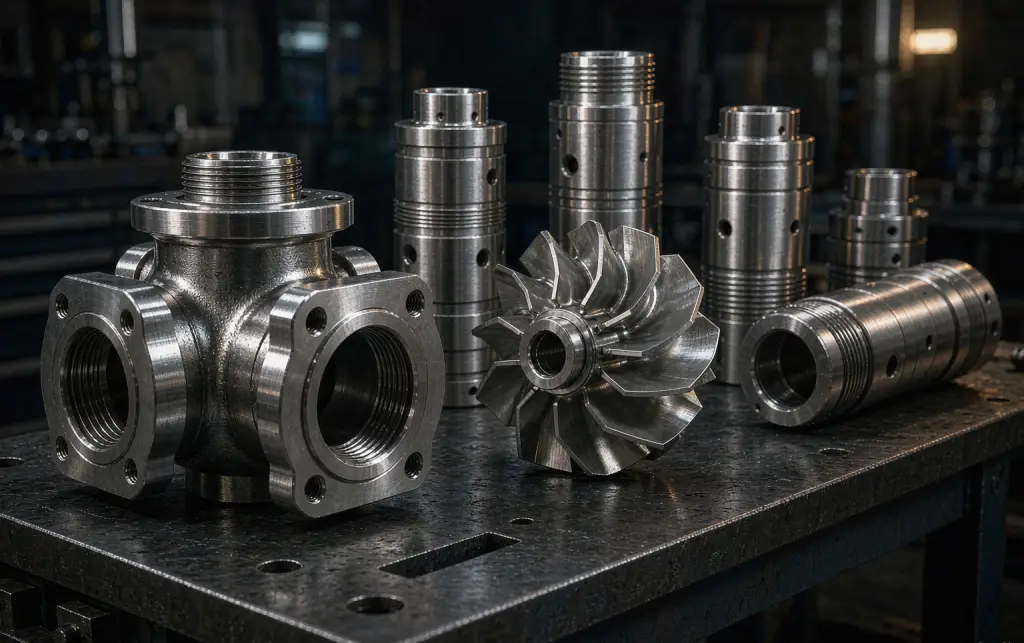
Oil & Gas Machining Components: A Buyer’s Guide to Materials, Tolerances and Finishing
Sourcing machined components for oilfield equipment is not like buying standard industrial parts. These parts go downhole where nobody can inspect them, sit in sour gas service for fifteen years, or cycle between pressure and temperature extremes that would fatigue ordinary steel in months. The machining itself is only half the job. Material selection, traceability and finishing decide whether a component survives in the field.
This guide covers the oil and gas components we machine most often, the materials worth specifying, the tolerances that actually matter, and what to include in an RFQ so you get accurate quotes the first time.
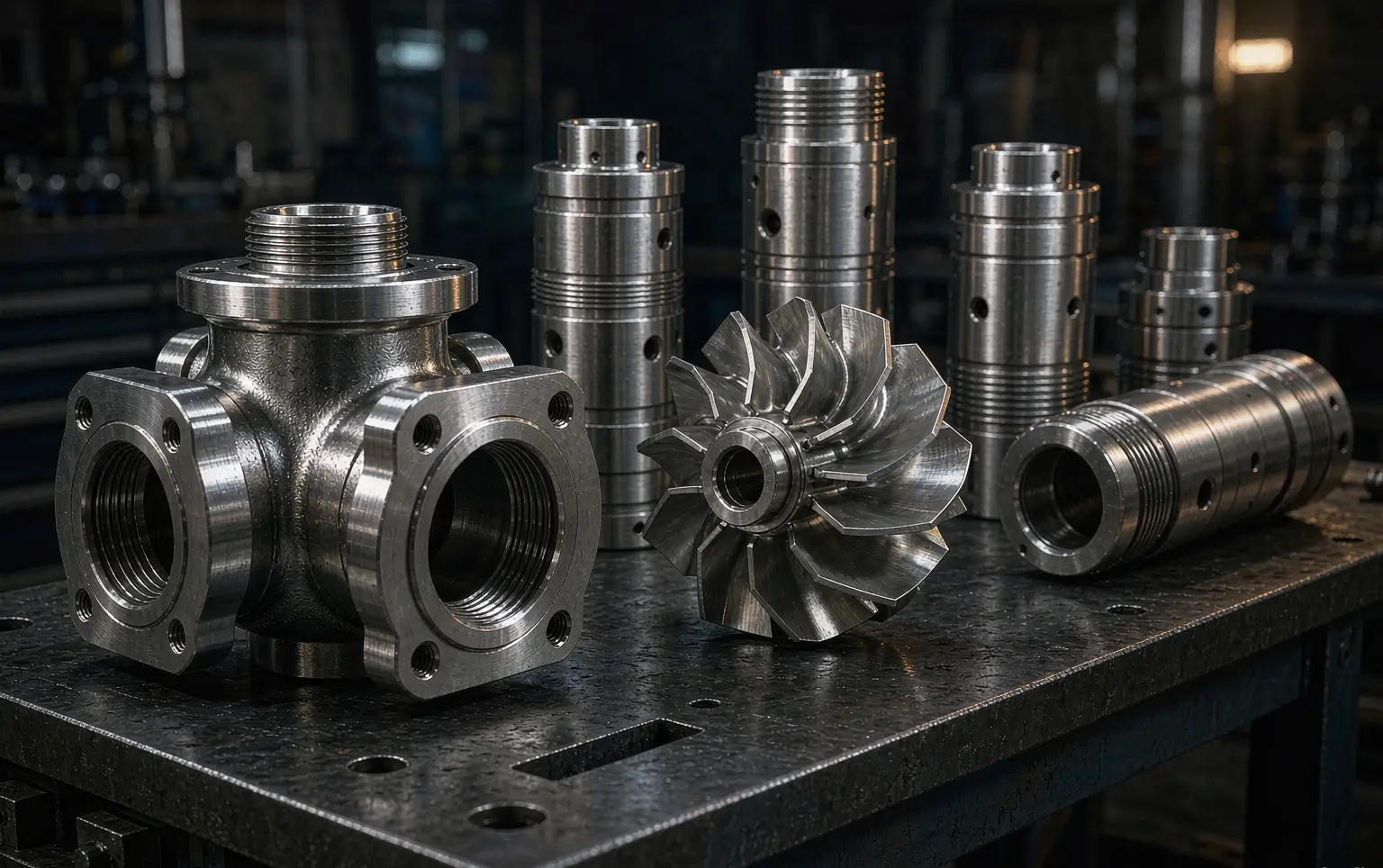
What makes oil and gas components different
Three conditions drive most engineering decisions in this industry:
- Corrosive media. H2S, CO2, chlorides and produced water attack standard alloys. NACE MR0175 / ISO 15156 compliance comes up constantly in sour service applications.
- Pressure and temperature cycles. Downhole tools see pressures above 15,000 psi and temperature swings of hundreds of degrees between runs.
- Expensive failures. A failed component can shut in a well, damage downhole assemblies, or create a safety incident. You are paying for process control, not just geometry.
If a supplier treats an oilfield part like a general industrial part, the savings on the quote get spent many times over later.
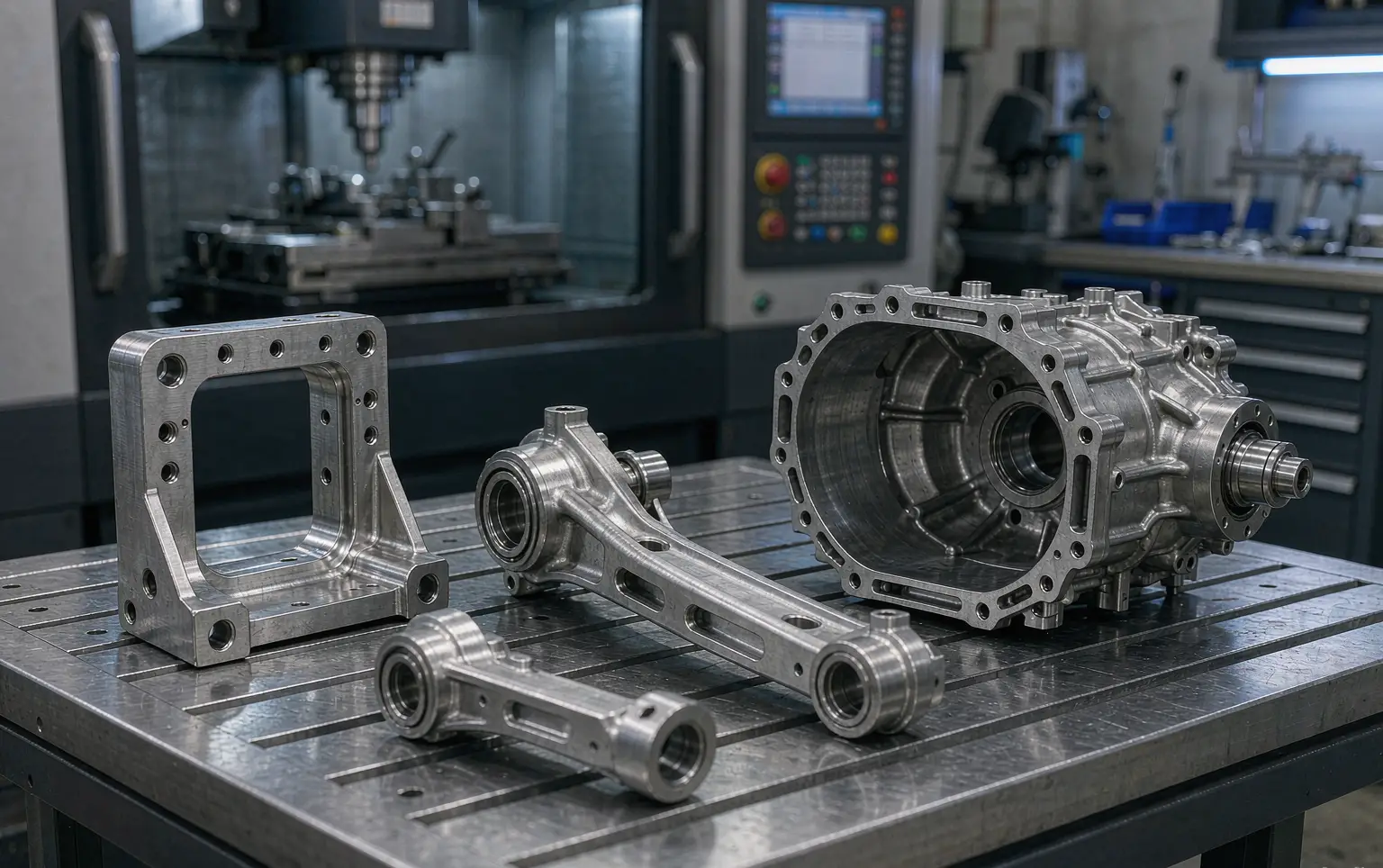
The components we machine most often
| Component | Common materials | Machining notes |
|---|---|---|
| Valve bodies, gates and seats | 4130/4140, 17-4PH, 316L, Inconel 718 | Sealing surfaces need tight finish and flatness; hardness testing after heat treatment |
| Pump impellers and shafts | 316L, duplex 2205, Monel K500 | Concentricity between bearing journals and impeller bores drives vibration behavior |
| Downhole tool housings and mandrels | 4140, Inconel 718, 15-5PH | Long bores with wall thickness variation; requires rigid boring setups |
| Flow control parts (chokes, plugs, orifices) | Tungsten carbide inserts, 17-4PH, ceramics | Hard turning and grinding operations for wear surfaces |
| Manifold blocks | 316L, F22, 4140 | Deep cross-drilled passages with pressure testing requirements |
| Sensor and electronics housings | 316L, titanium, Inconel 625 | Thin walls plus pressure-rated seals; often needs electropolishing for clean service |
Materials that hold up in the field
Material choice is where most cost and performance tradeoffs live. These are the workhorses:
| Alloy | Where it fits | Buyer notes |
|---|---|---|
| 4130 / 4140 alloy steel | Structural parts, tool joints, housings | Cost-effective but needs coating or plating for corrosion protection |
| 17-4PH stainless | Valve internals, shafts, fasteners | Confirm the aging condition (H900 through H1150); hardness affects machinability and sour service limits |
| 316L / duplex 2205 | Wetted components, pump parts | Duplex gives roughly double the strength; check workshop experience with it |
| Inconel 718 | Downhole tools, high-temperature service | Hard on tooling; shops without experience will quote high or miss tolerance. We machine Inconel regularly for aerospace and defense-grade applications |
| Monel K500 | Non-magnetic sour service parts | Age-hardenable; machining after aging is slow, so plan the sequence |
| Titanium Ti-6Al-4V | Seawater exposure, lightweight tooling | Cost driver; see our detailed titanium machining cost breakdown |
One practical tip: when a drawing allows several alloys, tell your supplier the operating environment instead of just picking one. We sometimes find a duplex or precipitation-hardening grade that meets the corrosion requirement at lower machining cost than the nickel alloy the drawing defaulted to.
Tolerances and inspection: specify what matters
The tightest tolerance on the drawing sets the price of the whole part. On oilfield components, the features that genuinely need precision are usually:
- Sealing diameters and faces where metal-to-metal seals or elastomer seals sit
- Thread forms, especially API and premium connections where profile, pitch and taper all get gauged
- Bore concentricity on rotating or pressure-containing assemblies
- Surface finish on flow-wetted paths, which affects both corrosion behavior and pressure drop
Everything else can often open up a grade without consequence. A drawing with three critical dimensions called out clearly gets quoted lower and delivered faster than one with uniform tight tolerances everywhere.
On the inspection side, expect a serious supplier to offer CMM reports on critical features, in-process checks on long runs, and coordination with third-party NDE (dye penetrant, magnetic particle or ultrasonic) when the spec calls for it. Ask where inspection happens in the process, not just whether it happens.
Finishing and coating options
Bare machined surfaces rarely survive oilfield service. The common post-machining treatments:
- Passivation for stainless parts to restore corrosion resistance after machining; details in our stainless steel passivation guide
- Electropolishing when you need a smooth, cleanable surface; see our electropolishing service overview
- Electroless nickel plating for combined corrosion and wear protection on steel components; our electroless nickel plating service page covers thickness and spec choices
- PTFE coatings on valve and fitting sealing surfaces; more in our PTFE coating guide
If corrosion protection is the primary concern, our longer piece on anti-corrosion coating for oil and gas parts walks through selection by service environment. For a broader look at the industry requirements overall, start with our overview of CNC machining in the oil and gas industry.
What to include in your RFQ
The difference between a useful quote and a guess usually comes down to what the RFQ contains. Before sending drawings out, make sure these are covered:
- Material specification with condition or heat treatment requirement
- NACE MR0175 / ISO 15156 applicability, including hardness limits
- Thread specifications and gauging requirements
- Pressure class and any test pressure requirements
- NDE type and acceptance level
- Coating or plating specification with thickness
- Certificate requirements (EN 10204 3.1 material certs are standard)
- Inspection level: first article only, sampling, or full dimensional layout
- Quantity schedule, including expected repeat volumes
RFQs that include these details get tighter pricing and fewer surprises during production. RFQs that omit them get padded quotes, because the supplier has to assume the worst case.
Frequently asked questions
What materials do you machine for sour service applications?
Commonly 17-4PH, 316L, duplex 2205, Inconel 718 and Monel K500. Sour service usually means hardness limits per NACE MR0175, which affects heat treatment routing and sometimes the machining sequence, so raise it early.
Can you work to NACE MR0175 / ISO 15156?
We machine to the material conditions your specification calls out, including the hardness restrictions. Compliance responsibility should be clarified during quoting, since it determines whether we handle heat treatment directly or coordinate with a certified treating partner.
What inspection documentation do you provide?
Standard deliverables include material certificates, dimensional inspection reports on called-out features, and full first-article inspection packages for new part numbers. CMM data comes with the reports.
What is a realistic lead time for oilfield components?
Simple components in stock alloys run roughly 1-2 weeks. Parts needing heat treatment, NDE or plating typically run 3-5 weeks because of external process steps. Long-lead alloys like some duplex and nickel grades add procurement time.
Do you handle both prototypes and production quantities?
Yes. Oilfield programs we support usually start with prototype or pilot quantities, then move into repeat production with the same process data. That continuity is one of the fastest ways to keep quality stable across builds.
Ready to quote?
Send drawings and requirements to our engineering team and you will get feedback on material selection, tolerances and manufacturability along with the quote. If your spec has options open, we will tell you where the money is going before you commit.