MIL-DTL-81706 Chem Film Materials: Picking the Right Conversion Coating for Your Callout
Writing “chemical conversion coating per MIL-DTL-5541” on a drawing only defines what the part must pass. It does not define which process chemistry runs in the tank. That second half is controlled by MIL-DTL-81706, the material specification that qualifies conversion coating products for aluminum. When the two get mixed up, RFQs arrive without a form, type or class, and parts come back with coatings that measure fine on weight but fail the conductivity or corrosion test that actually mattered. This guide separates the two documents, explains the form, type and class options inside 81706, and shows how to pick a qualified material that satisfies both the drawing and the buyer’s compliance requirements.
What MIL-DTL-81706 Actually Controls
MIL-DTL-81706 is a material specification. It defines the tests a chemical conversion coating product must pass before it can be listed on the Qualified Products List (QPL-81706), and it defines how that product must be applied and verified. MIL-DTL-5541 is the part specification: it states the corrosion resistance and electrical performance the finished part must show, and it requires that the process be run with a material qualified under 81706.
- MIL-DTL-5541 = what the finished part must achieve (corrosion resistance, conductivity, coating weight).
- MIL-DTL-81706 = which coating chemistries are qualified to deliver it, and how they are controlled in production.
- QPL-81706 = the list of commercially qualified products, with their form, type and class approvals.
A practical consequence for buyers: a supplier saying “we do chem film per 5541” should be able to name the 81706-qualified product they run, its form and type, and the QPL listing. If those three things cannot be answered, the process is not traceable to the spec.
Type I vs Type II: The Hexavalent Chrome Decision
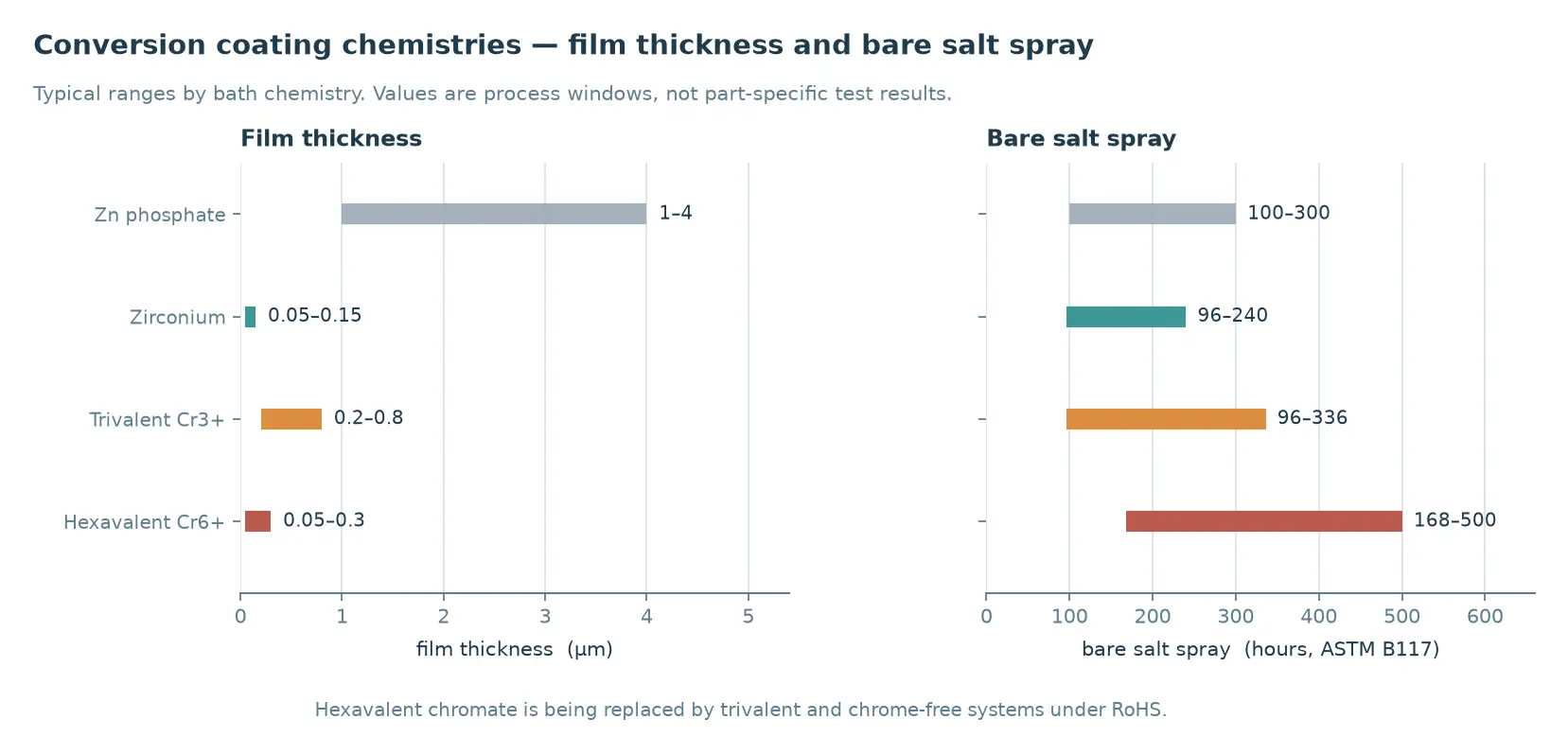
Type I coatings contain hexavalent chromium; Type II coatings are non-hexavalent, typically trivalent chromium chemistries. The choice is usually driven by compliance, not performance.
- Type I (hexavalent): the traditional chemistry, long associated with products such as Alodine 1200. It offers proven corrosion performance and self-healing behavior, but hexavalent chromium is heavily restricted under REACH and RoHS-related requirements. Using it generally triggers extra documentation for European customers.
- Type II (non-hexavalent): trivalent chromium systems such as SurTec 650 and similar QPL-listed products. These dominate new designs because they satisfy environmental compliance while meeting 5541 corrosion and Class 3 conductivity requirements.
One caution from production: Type II films are thinner and more sensitive to processing windows than Type I. Contact resistance and corrosion results depend more on bath control, so the supplier’s process discipline matters more with Type II than with legacy chemistry.
Class 1A vs Class 3: Protection or Conductivity
The class decides what the coating is optimized for, and it must appear on the drawing.
- Class 1A: maximum corrosion protection. The film is heavier, and it is the default choice where the conversion coating is the final finish, or the base for paint and primer. Class 1A films are not intended to carry electrical current.
- Class 3: low electrical resistance where conductivity matters. Corrosion protection is provided, but the film is kept thin enough to pass contact resistance testing. This is the class behind virtually every ground path and EMI gasket interface on an electronics chassis.
If a drawing only says “chem film” with no class, ask. The two classes use different inspection criteria, and guessing wrong means rework at final inspection.
Form I and Form II: Liquid vs Powder
81706 also classifies qualified products by supply form. Form I covers liquid concentrates; Form II covers dry powder. Both can exist in Type I and Type II, Class 1A and Class 3 approvals, so the QPL entry is always read as a combination: product, form, type and class. For a shop this is mostly a bath management question; for a buyer it matters only as part of verifying the supplier’s QPL listing is complete for the class specified on the drawing.
Coating Weight and Thickness Expectations
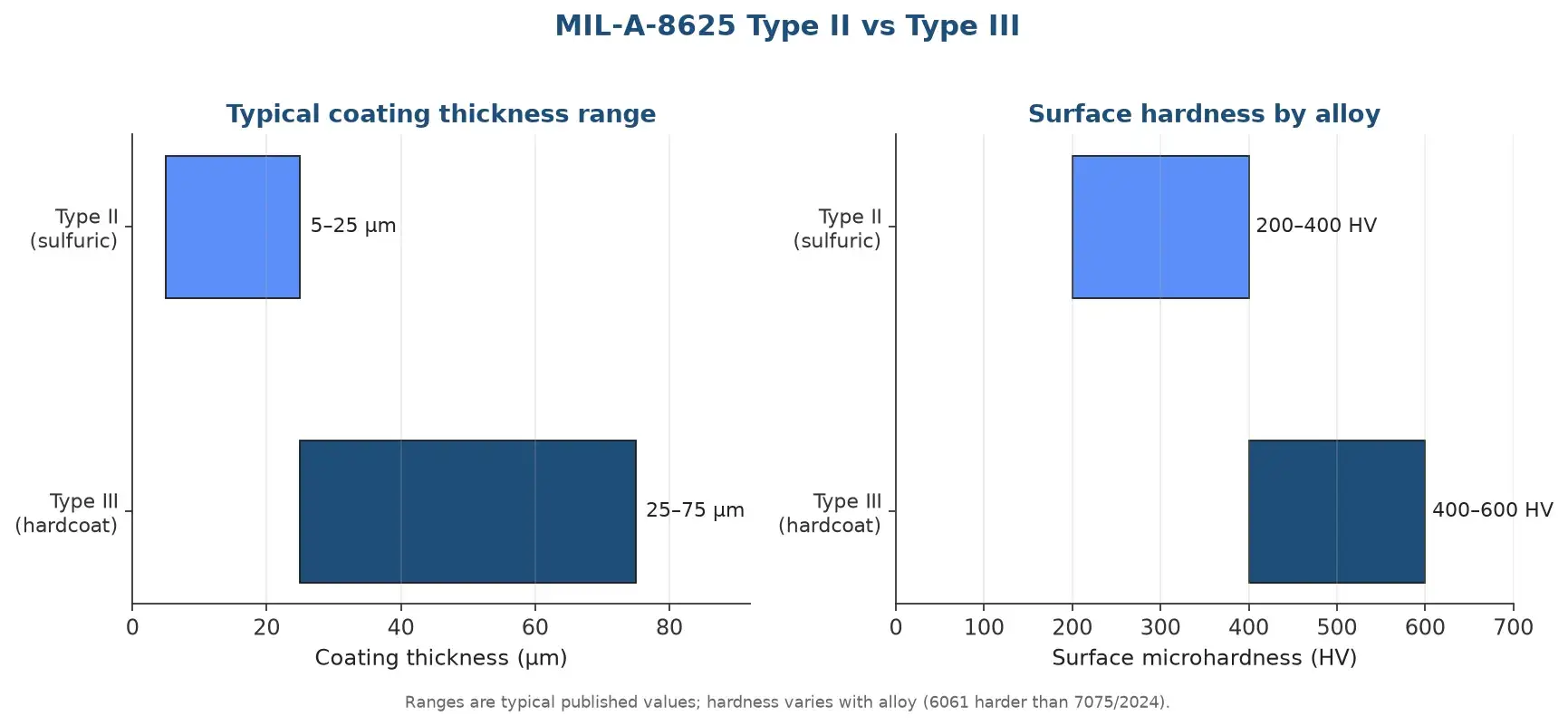
Conversion coatings are specified by coating weight, not thickness. Typical chem film results fall in the range of a few hundred milligrams per square foot, with the exact value depending on class, alloy and bath control. Unlike anodize, the film builds essentially no measurable dimension, which is why chem film is the finish of choice for parts with tight fits, threads and precision bores that cannot tolerate dimensional growth. Where a drawing carries both chem film and a tight tolerance on the same feature, the two are compatible because the coating does not move the size.
For parts that need both corrosion protection and a hard, dimensionally growing layer, the usual route is a discussion between anodize and chem film rather than stacking them. Our guides on MIL-A-8625 Type II and MIL-A-8625 Type III hard anodize cover that trade-off in detail.
Corrosion Testing: What Acceptance Looks Like
Acceptance under 5541 centers on salt spray exposure. Coated test panels are exposed per ASTM B117, with the duration and pass criteria depending on class and whether the coating is used alone or as a paint base. In plain language: Class 1A panels are expected to survive a long salt spray exposure with limited corrosion products, and Class 3 panels must also demonstrate contact resistance within limits after exposure. The tests are run on qualified panels accompanying the production load, not by dissecting machined parts.
Electrical Requirements for Class 3
Class 3 acceptance adds contact resistance testing, with limits expressed in milliohms at a specified contact pressure. Two production realities are worth knowing as a buyer:
- Contact resistance is measured on witness panels processed with the production load, so panel handling and curing time are part of the part quality even though the parts themselves are not tested destructively.
- Post-treatment matters. Parts that are subsequently painted, masked with pressure-sensitive tape over contact areas, or handled with bare hands can show contact resistance drift. Specify contact areas on the drawing and keep them free of subsequent operations.
Reading the QPL Entry Correctly
A QPL-81706 listing is not a single approval per product. One commercial product can hold several listings: for example, a trivalent chromium product commonly holds Form I and Form II approvals in Type II, and separately in Class 1A and Class 3, with the exact combinations shown in the listing. When a supplier reports the process used, the traceable answer has four parts: product name, form, type and class. “We ran SurTec 650, Form I, Type II, Class 3” is a complete answer; “we ran chem film” is not.
Alloy Considerations: 2xxx and 7xxx Are Different
Chem film responds to the copper content of the alloy. High-copper alloys such as 2024 convert readily and build film fast, but the same chemistry on low-copper alloys like 6061 or on die-cast variants produces thinner, less uniform films if the bath is not controlled for that alloy. High-silicon castings are the most demanding. Suppliers who run mixed-alloy loads control bath chemistry against the alloy mix; this is one of the quiet reasons two shops running the same QPL product can produce different corrosion results on the same drawing.
Common Drawing Errors That Cause Rework
- Citing MIL-C-5541, the superseded letter revision, without mapping it to MIL-DTL-5541. The old and new designations are covered in our MIL-C-5541 vs MIL-DTL-5541 mapping guide.
- Specifying Class 3 on a part that is later painted. Paint over Class 3 defeats the conductivity purpose; use Class 1A as the paint base.
- Leaving the type unstated and assuming the shop will infer RoHS-compliant Type II. State it.
- Requesting chem film “per 81706” on the part. Parts are coated per 5541; 81706 belongs in the process traceability, not on the part callout.
Chem Film as a Paint and Primer Base
A large share of Class 1A chem film is not a final finish at all: it is the pretreatment under paint, primer or wet film systems on aerospace and defense hardware. The conversion layer improves paint adhesion and adds a first line of corrosion defense under the coating system. In this role the drawing often calls out the chem film per 5541 Class 1A and the paint system separately, and both must be processed on the same qualified line. Sequence matters: chem film first, then paint within the process window, with the film kept intact between the two operations. Scratches through the film at this stage become corrosion initiation points under the paint later.
What Drives Cost and Lead Time on Chem Film Orders
Chem film itself is one of the lower-cost finishes per part, but three factors move the quote:
- Masking density. Every masked bore, thread and contact area is manual work before and after the tank; a part with heavy masking can cost more to finish than to machine.
- Certification overhead. Witness panels, salt spray coupons and traceability records per lot add fixed cost that is spread thinner on small orders.
- Paint pairing. Orders that combine chem film with a primer or paint system under a second spec carry two process controls and two acceptance records.
On small batches the certification overhead is the usual reason the per-part finish cost looks high relative to the part size. The cost does not scale down with quantity the way machining hours do.
How JLYPT Runs Chem Film Work
JLYPT machines and chem-film finishes CNC aluminum in one workflow, so the coating lot follows the machining lot without a second outside supplier. Production runs with QPL-listed materials in both Type I and Type II chemistry, in Class 1A and Class 3, with witness panels and bath records per load. Typical RFQ information we need: alloy and temper, drawing revision, coating type and class, masked or contact areas, and acceptance tests required by the end customer.
RFQ Checklist for Chem Film Parts
- Alloy and temper (e.g. 6061-T6, 2024-T351, 7075-T7351).
- Coating callout: MIL-DTL-5541, type and class, plus any customer-specific QPL product requirement.
- Masking: holes, bores, threads and conductive contact areas that must stay uncoated or stay conductive.
- Acceptance: salt spray duration, contact resistance limits, or compliance documentation required.
- Quantity and lead time, including whether test panels must accompany the shipment.
For a chem film or anodize project, submit the alloy, drawing revision, quantity and coating requirements through the JLYPT quote form. State the required type and class, masked areas and acceptance tests so the quotation matches the drawing.
Summary
MIL-DTL-81706 is the material half of every chem film callout: it decides which qualified chemistry runs, in which form, type and class, and it feeds the QPL that makes the process traceable. Parts are specified under MIL-DTL-5541; processes are qualified under 81706. Get the pairing right on the RFQ and the coating arrives matching the drawing, the conductivity test and the compliance paperwork on the first pass.
For the part-level acceptance requirements behind these materials, read our MIL-DTL-5541 Class 3 conductive chem film guide, and for quotation-ready service details see the MIL-DTL-5541 conversion coating service page.