CNC Machining Cost: Complete Pricing Guide (2026)
What Determines CNC Machining Cost?
CNC machining cost is influenced by six primary factors that interact with each other throughout the manufacturing process. Understanding these cost drivers helps you make informed decisions during the design phase.
The Six Cost Drivers
| Cost Factor | Impact on Total Cost | Control Level |
|---|---|---|
| Material selection | 20-40% | High (design choice) |
| Part complexity | 15-30% | Medium (design optimization) |
| Tolerance requirements | 10-25% | Medium (specification review) |
| Quantity / volume | 10-20% | High (order planning) |
| Surface treatment | 5-15% | Medium (finish selection) |
| Lead time | 5-20% | High (project planning) |
Material selection typically has the largest impact on CNC machining cost. A part machined from aluminum 6061 will cost significantly less than the same part machined from titanium Grade 5, even with identical geometry and tolerances. The material affects not only raw stock price but also machining time, tool wear, and scrap rates.
Part complexity drives machining time, which directly translates to machine-hour costs. A simple bracket might take 10 minutes to machine, while a complex aerospace housing with multiple features could require several hours of 5-axis machining.
For a detailed breakdown of our CNC machining services and capabilities, visit our service page.
Material Costs and Selection Impact
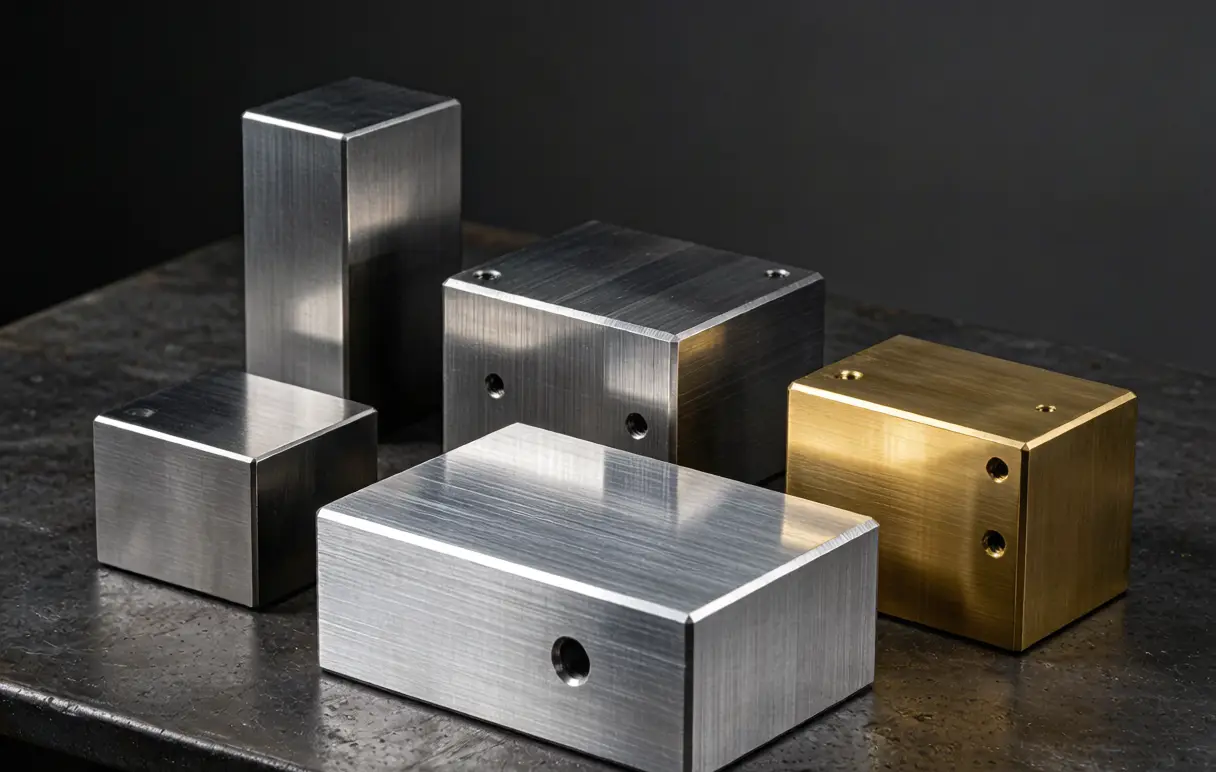
Material choice is the single most significant variable in CNC machining cost. Here’s a comprehensive comparison of commonly machined materials and their relative cost impact.
Material Cost Comparison
| Material | Relative Cost (1-10) | Machinability | Typical Applications |
|---|---|---|---|
| Aluminum 6061 | 2 | Excellent | Brackets, housings, prototypes |
| Aluminum 7075 | 4 | Good | Aerospace, high-stress parts |
| Brass C360 | 3 | Excellent | Fittings, decorative parts |
| Stainless Steel 304 | 4 | Moderate | Food grade, general purpose |
| Stainless Steel 316 | 5 | Moderate | Marine, chemical processing |
| Steel 1018 | 2 | Good | Shafts, spacers, structural |
| Titanium Grade 2 | 7 | Poor | Chemical, marine |
| Titanium Grade 5 (Ti-6Al-4V) | 8 | Very Poor | Aerospace, medical implants |
| Inconel 718 | 9 | Very Poor | Turbine parts, extreme environments |
| PEEK | 6 | Good | Medical, aerospace, chemical |
| Delrin (POM) | 2 | Excellent | Gears, bearings, prototypes |
How Material Affects Total Cost
Material cost extends beyond raw stock price. Harder materials like titanium and Inconel require:
- Slower machining speeds: 40-70% reduction in feed rates
- More frequent tool changes: Carbide tool life reduced by 50-80%
- Specialized tooling: Polycrystalline diamond (PCD) or ceramic inserts
- Longer cycle times: Overall machining time increased 2-4x
For example, a part that costs $50 in aluminum 6061 might cost $180 in titanium Grade 5 — not because the titanium stock costs $130 more, but because the machining time triples and tool wear increases dramatically.
Aluminum remains the most cost-effective material for most CNC machining projects. Our custom aluminum anodizing services can enhance aluminum parts with corrosion resistance and aesthetic finishes at minimal additional cost.
How Part Complexity Affects Price
Part complexity is the second-largest driver of CNC machining cost. Complex geometries require more setup time, multiple operations, and often specialized multi-axis equipment.
Complexity Tiers and Cost Impact
Tier 1: Simple Parts (Baseline Cost)
- 2D profiles, holes, pockets
- Single setup (3-axis machining)
- Standard tolerances (±0.1mm)
- Examples: brackets, plates, spacers
Tier 2: Moderate Complexity (1.5-2.5x Baseline)
- Multiple features on several faces
- 2-3 setups required
- Some tight tolerances (±0.05mm)
- Threads, counterbores, chamfers
- Examples: housings, mounts, fittings
Tier 3: High Complexity (3-5x Baseline)
- Complex 3D contours, undercuts
- 4-5 axis machining required
- Multiple tight tolerances (±0.01mm)
- Thin walls, deep pockets, internal features
- Examples: impellers, turbine blades, medical implants
Tier 4: Very High Complexity (5-10x Baseline)
- Simultaneous 5-axis machining
- Extremely tight tolerances (±0.005mm)
- Exotic materials combined with complex geometry
- Multiple precision setups
- Examples: aerospace structural components, optical housings
Design Features That Increase Cost
| Feature | Cost Increase | Reason |
|---|---|---|
| Deep pockets (depth > 4x width) | +20-40% | Specialized tooling, multiple passes |
| Thin walls (< 1mm) | +30-60% | Vibration issues, slow feeds |
| Internal threads (deep) | +15-25% | Tapping challenges, breakage risk |
| Undercuts | +25-50% | Special tools, additional setups |
| Surface finish (Ra < 0.4) | +20-40% | Additional finishing passes |
| Sharp internal corners | +15-30% | EDM or special tooling needed |
Our 5-axis CNC machining capabilities handle complex geometries efficiently, reducing setups and overall cost for intricate parts.
Tolerance Requirements and Cost
Tighter tolerances directly increase CNC machining cost because they require slower machining speeds, more frequent inspection, higher scrap rates, and potentially specialized equipment.
Tolerance Cost Multiplier
| Tolerance Range | Cost Multiplier | Typical Application |
|---|---|---|
| ±0.1mm (Standard) | 1.0x | General purpose, non-critical |
| ±0.05mm (Fine) | 1.2-1.5x | Most engineered parts |
| ±0.02mm (Precision) | 1.5-2.0x | Bearings, mating parts |
| ±0.01mm (High Precision) | 2.0-3.0x | Precision instruments |
| ±0.005mm (Ultra Precision) | 3.0-5.0x | Aerospace, medical implants |
Design for Tolerance Optimization
Not every feature on a part needs tight tolerances. Applying precision tolerances only where functionally required can reduce cost significantly.
Cost-saving approach: Specify ±0.1mm for non-critical features and reserve ±0.02mm or tighter tolerances for bearing surfaces, mating diameters, and alignment features. This selective tolerance strategy can reduce machining cost by 20-30%.
Our quality control processes, documented on our precision quality control page, ensure tolerances are met consistently across production runs.
Quantity and Volume Pricing
Quantity has a significant impact on per-unit CNC machining cost due to the amortization of setup and programming costs across more parts.
Volume Pricing Tiers
| Quantity | Per-Unit Cost (vs. 1pc) | Setup Cost Per Unit | Best For |
|---|---|---|---|
| 1-10 (Prototype) | 100% (baseline) | High | Design validation |
| 10-50 (Low volume) | 70-85% | Moderate | Pilot production |
| 50-200 (Bridge) | 55-70% | Low | Market testing |
| 200-1,000 (Medium) | 40-55% | Minimal | Production ramp |
| 1,000-10,000 (High) | 30-45% | Negligible | Full production |
| 10,000+ (Mass) | 25-35% | Negligible | Mass production |
The Setup Cost Effect
Setup cost — which includes fixturing, tool preparation, CNC programming, and first-article inspection — is typically $100-500 per setup. For a single prototype, this entire cost is applied to one part. At 1,000 pieces, the same setup cost adds only $0.10-0.50 per part.
This is why JLYPT offers no minimum order quantity — you can order exactly what you need, whether it’s one prototype or 100,000 production parts.
Surface Treatment Cost Adders
Surface treatments add functionality and aesthetics but also add cost. Understanding the cost-benefit ratio of each treatment helps you make smart finishing decisions.
Surface Treatment Cost Guide
| Treatment | Cost Adder (vs. raw) | Processing Time | Key Benefit |
|---|---|---|---|
| Anodizing Type II | +5-15% | 1-2 days | Corrosion resistance, color |
| Anodizing Type III (Hardcoat) | +10-20% | 2-3 days | Wear resistance, durability |
| Powder Coating | +8-15% | 1-2 days | Durability, thick coating |
| Electroless Nickel Plating | +10-18% | 2-3 days | Uniform coating, corrosion |
| Passivation | +3-8% | 1 day | Stainless steel corrosion |
| Black Oxide | +3-7% | 1 day | Aesthetic, mild corrosion |
| Electropolishing | +8-15% | 1-2 days | Surface smoothness, cleanability |
| Brushing/Polishing | +5-12% | 1 day | Aesthetic finish |
For detailed specifications on surface treatments, see our surface finishing services page, or read our technical guides on electroless nickel plating and powder coating.
Setup and Programming Costs
Setup and programming costs are often overlooked but can represent 15-30% of total CNC machining cost, especially for low-volume orders.
Programming Cost Factors
- CAM programming: $50-150/hour for complex parts
- Fixture design and fabrication: $100-500 per custom fixture
- Tool selection and preparation: $50-200 per setup
- First article inspection: $50-200 per part
Reducing Setup Costs
- Design for standard fixtures: Use standard vise sizes and clamping patterns
- Minimize setups: Design parts to be completed in 1-2 setups
- Use stock sizes: Design around standard material stock dimensions
- Provide complete documentation: Full drawings, 3D models, and specifications reduce interpretation time
Lead Time Impact on Pricing
Lead time significantly affects CNC machining cost. Rush orders typically carry a 25-100% premium.
Lead Time Pricing Structure
| Lead Time | Cost Premium | Availability |
|---|---|---|
| Standard (2-3 weeks) | Baseline | Always available |
| Expedited (1 week) | +20-40% | Most materials |
| Rush (3-5 days) | +40-75% | Limited materials |
| Emergency (1-2 days) | +75-150% | Aluminum, common plastics only |
Planning ahead and ordering with standard lead times can save 20-40% on CNC machining cost. For urgent projects, our rapid prototyping services offer expedited turnaround with transparent pricing.
CNC Machining Cost Examples
Example 1: Aluminum Bracket (Simple Part)
| Material | Aluminum 6061 |
| Dimensions | 100 × 60 × 10mm |
| Complexity | Tier 1 (simple) |
| Tolerance | ±0.1mm |
| Surface finish | Raw (no treatment) |
| Cost (1 pc) | $25-45 |
| Cost (100 pc) | $8-15/pc |
| Cost (1,000 pc) | $5-10/pc |
Example 2: Stainless Steel Housing (Moderate Complexity)
| Material | Stainless Steel 316 |
| Dimensions | 80 × 60 × 40mm |
| Complexity | Tier 2 (moderate) |
| Tolerance | ±0.05mm |
| Surface finish | Passivation |
| Cost (1 pc) | $80-150 |
| Cost (100 pc) | $35-60/pc |
| Cost (1,000 pc) | $20-40/pc |
Example 3: Titanium Aerospace Component (High Complexity)
| Material | Titanium Grade 5 |
| Dimensions | 120 × 80 × 30mm |
| Complexity | Tier 3 (high) |
| Tolerance | ±0.02mm |
| Surface finish | Shot peening |
| Cost (1 pc) | $350-600 |
| Cost (50 pc) | $180-300/pc |
| Cost (500 pc) | $120-200/pc |
10 Strategies to Reduce CNC Machining Cost
1. Design for Manufacturability (DFM)
Simplify part geometry by avoiding unnecessary features. Every additional feature adds machining time and cost. Use standard hole sizes, avoid deep pockets, and minimize the number of setups required.
2. Select Cost-Effective Materials
Choose aluminum 6061 for prototypes and non-critical parts. Only specify exotic materials like titanium or Inconel when the application truly demands their properties. Our comprehensive CNC machining equipment handles 100+ materials efficiently.
3. Optimize Tolerances
Apply tight tolerances only where functionally necessary. Use ±0.1mm for non-critical features and ±0.02mm only for mating surfaces and precision interfaces.
4. Increase Order Quantity
If you anticipate needing more parts, order them together. The per-unit cost drops dramatically from prototype to production quantities due to setup cost amortization.
5. Use Standard Stock Sizes
Design parts around standard material stock dimensions to minimize material waste and machining time. Avoid specifying non-standard thicknesses that require custom material sourcing.
6. Minimize Surface Treatment
Only specify surface treatments where functionally required. A raw aluminum part may be sufficient for internal components, saving 5-15% on finishing costs.
7. Avoid Tight Lead Times
Plan projects to use standard lead times (2-3 weeks). Rush orders can add 40-150% to the total cost. For projects that genuinely need fast turnaround, our 3D printing services offer an alternative for rapid prototyping.
8. Consolidate Parts
Design assemblies as single parts where possible. Combining multiple components into one machined part eliminates assembly time, reduces part count, and often reduces total cost.
9. Provide Complete Documentation
Submit complete 2D drawings with GD&T, 3D STEP files, and material specifications. Incomplete documentation leads to quotes based on worst-case assumptions, inflating estimated cost.
10. Partner with an Integrated Manufacturer
Working with a manufacturer that offers machining, surface treatment, and quality inspection under one roof eliminates supply chain overhead and reduces coordination costs. Contact JLYPT for integrated manufacturing solutions with transparent pricing.
CNC Machining Cost Calculator
While exact pricing requires a detailed quote based on your specific part, here’s a simplified cost estimation framework:
Quick Cost Estimation Formula
Estimated Cost = (Material Cost) + (Machining Time × Hourly Rate) + (Setup Cost / Quantity) + (Surface Treatment) + (Inspection)
Typical hourly rates:
- 3-axis CNC: $40-80/hour
- 5-axis CNC: $80-150/hour
- EDM wire cutting: $60-120/hour
- Swiss-type turning: $50-100/hour
Cost Optimization Checklist
Use this checklist when requesting a quote to ensure you get the best price:
- Material specified with alternative options
- Tolerances applied only where necessary
- Surface finish specified by functional requirement
- Part designed for minimal setups
- Standard stock sizes used
- Complete documentation provided
- Quantity optimized for volume pricing
- Lead time allows standard processing
Frequently Asked Questions
How much does CNC machining cost per hour?
CNC machining hourly rates range from $40-150/hour depending on machine type. 3-axis machining costs $40-80/hour, while 5-axis machining costs $80-150/hour. EDM and Swiss-type machines fall in the $50-120/hour range. The total cost depends on machining time, material, and complexity.
What is the cheapest material for CNC machining?
Aluminum 6061 is typically the most cost-effective material for CNC machining due to its excellent machinability, wide availability, and affordable raw stock price. Delrin (POM) and steel 1018 are also economical choices for specific applications.
How can I reduce my CNC machining cost?
The most effective ways to reduce CNC machining cost include: simplifying part geometry, selecting cost-effective materials, applying tight tolerances only where necessary, ordering in higher quantities, using standard stock sizes, and allowing standard lead times.
Does CNC machining cost include surface treatment?
Surface treatment is typically quoted as an additional cost. Basic treatments like passivation add 3-8%, while more complex treatments like electroless nickel plating add 10-18%. Always clarify what’s included in your quote.
What is the minimum order quantity for CNC machining?
Many CNC machining services require minimum order quantities, but JLYPT offers no MOQ — you can order from a single prototype to 100,000+ production parts. This flexibility allows you to validate designs cost-effectively before committing to volume production.
How accurate are online CNC machining cost calculators?
Online cost calculators provide rough estimates (±30-50%) based on general parameters. For accurate pricing, submit your complete drawings and specifications for a detailed quote. Factors like part complexity, tolerance requirements, and material availability can significantly affect the final price.
Is CNC machining cheaper than 3D printing?
For single prototypes, 3D printing is often cheaper and faster. However, as quantity increases (typically above 20-50 parts) or when specific material properties are required, CNC machining becomes more cost-effective per unit. CNC also produces stronger, more precise parts.
Conclusion
CNC machining cost is driven by material selection, part complexity, tolerance requirements, order quantity, surface treatment, and lead time. By understanding these cost factors and applying the optimization strategies outlined in this guide, you can reduce your manufacturing expenses by 20-40% without compromising part quality or performance.
The key to cost-effective CNC machining is early collaboration with your manufacturing partner. By involving JLYPT’s engineering team during the design phase, you can identify cost-saving opportunities before production begins, ensuring your parts are optimized for both performance and manufacturability.
Ready to get an accurate quote for your project? Contact JLYPT today for a free DFM analysis and detailed cost breakdown. Our ISO 9001-certified facility delivers precision parts with transparent pricing and no minimum order quantity.