MIL-A-8625 Type I Chromic Acid Anodize: The Thin, Fatigue-Friendly Aerospace Finish
Type I is the anodize that shows up on legacy aerospace drawings when fatigue matters and dimensional change cannot be tolerated. It runs in a chromic acid electrolyte, builds the thinnest anodic film of any MIL-A-8625 type, and leaves the fatigue strength of the base alloy almost untouched. It also carries hexavalent chromium, which is why the compliance conversation around it has changed dramatically over the past decade. This guide explains what the Type I callout actually specifies, where its alloy limits sit, how the voltage ramp works, what sealing does, and how the Type IB and Type IC designations map into the same document, so the next RFQ you send carries complete and buildable information.
What the Type I Callout Specifies
MIL-A-8625 is the military specification for anodic coatings on aluminum and aluminum alloys. Type I is the chromic acid anodize designation: a 3 to 10 percent chromic acid (CrO₃) electrolyte, typically run at a bath temperature of 32 to 40 °C. The finished film is thin, opaque gray to greenish gray, and mostly valued for corrosion protection and paint adhesion rather than wear or appearance. Note that the document has been redesignated MIL-PRF-8625 (Rev F, Amendment 2, 2020); legacy callouts to MIL-A-8625 remain understood, and new drawings may cite either, but the technical content of the Type I requirement is unchanged.
Two classes apply across the types: Class 1 is non-dyed (natural finish, including dichromate sealing) and Class 2 is dyed. In practice, Type I films take dye poorly because the oxide structure is dense and low-porosity, so the overwhelming majority of Type I work is Class 1. If a drawing asks for dyed chromic anodize, it usually indicates a spec mismatch worth clarifying before quoting.
The Voltage Ramp Is the Process
Unlike sulfuric anodize, which holds a fairly constant voltage, chromic anodize ramps voltage from near zero up to around 40 V over the cycle. The slow ramp keeps current density low and prevents burning on thin sections, producing a fine, dense, relatively non-porous film. Two production consequences matter to buyers:
- Because the film is dense and low-porosity, dye uptake is poor and the coating seals well with hot water or sodium dichromate solutions.
- The ramp procedure makes the process sensitive to racking contact and part mix; a rack with mixed alloys and thin sections needs more process control than a load of identical brackets.
Type IB is the low-voltage variant of the same chemistry, using roughly 20 to 22 V instead of 40 V. It produces a similar thin film and is the preferred designation for 7000-series alloys, where the higher-voltage Type I cycle can be less consistent. If your drawing says Type I and the parts are 7075 or 7050, expect a competent supplier to quote it as Type IB or to confirm the substitution in writing.
Thickness and Dimensional Impact: Why Threads Tolerate It
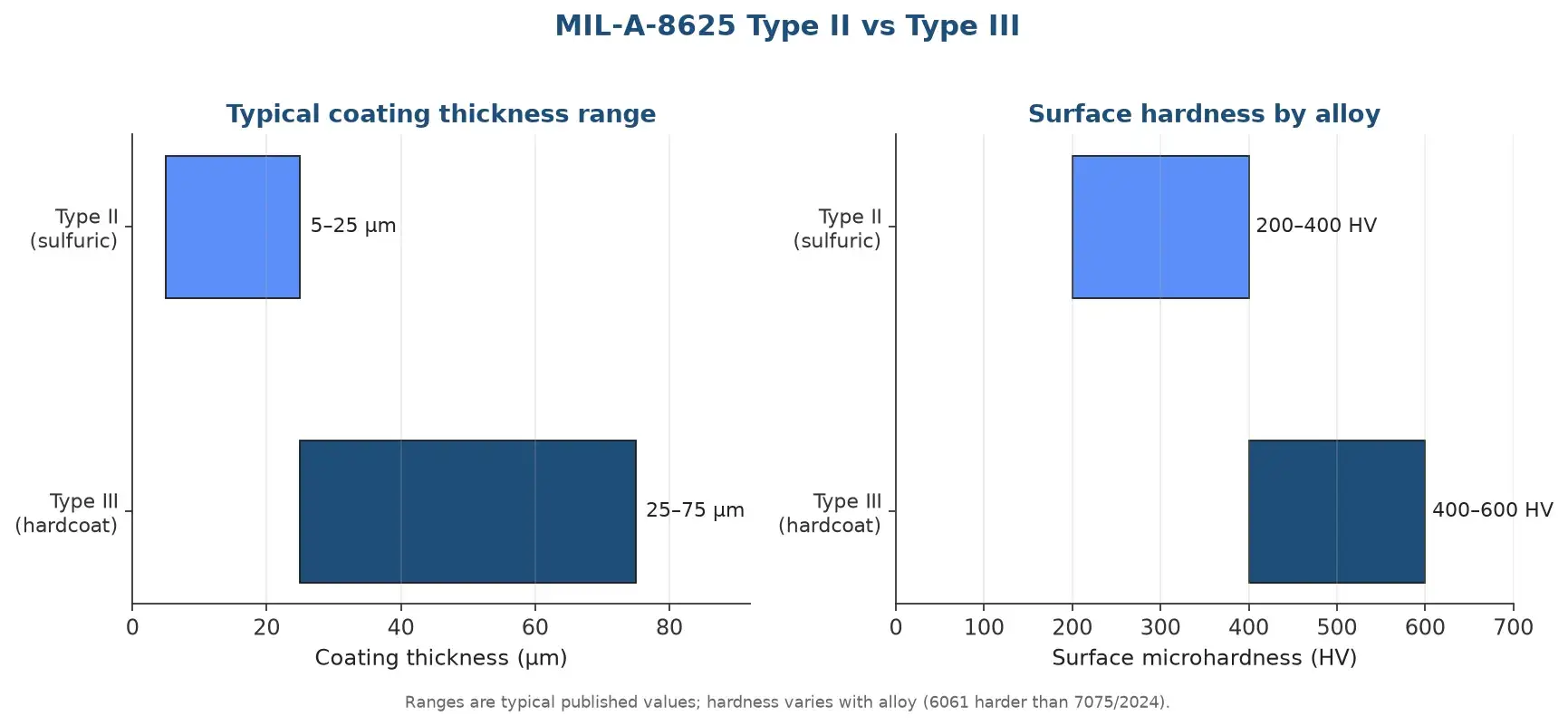
Type I coatings run from about 0.5 to 7.6 µm (0.00002 to 0.0003 inch), with the specification requiring a minimum unsealed coating weight of 200 mg/ft². The film builds roughly half penetration into the base metal and half outward, so dimensional growth is on the order of half the film thickness per surface. At chromic thicknesses that growth is often under 0.00005 inch per side, small enough that anodized threads, precision bores and faying surfaces stay within typical machining tolerances. This is the main reason Type I survives on assemblies where a Type II film at 2 to 25 µm would eat the tolerance stack.
For comparison, the thickness trade across the 8625 family looks like this:
| Property | Type I / IB | Type II | Type III |
|---|---|---|---|
| Electrolyte | Chromic acid 3 to 10 percent | Sulfuric acid 15 to 20 percent | Sulfuric acid, low temperature |
| Bath temperature | 32 to 40 °C | 20 to 22 °C | 0 to −2 °C range |
| Voltage | Ramped to 40 V (IB: 20 to 22 V) | 15 to 22 V | 40 V and above |
| Thickness | 0.5 to 7.6 µm | 2 to 25 µm | Per drawing, typically 50 to 100 µm |
| Sealing | Required | Required | Optional; unsealed for maximum wear |
| Fatigue impact | Minimal | Moderate | Highest of the three |
| Typical role | Fatigue-critical parts, paint base | General corrosion protection, dyeable | Wear surfaces, dielectric |
The thicker-film end of the comparison is covered in our guide to MIL-A-8625 Type III hard anodize, and the general-purpose middle ground in our MIL-A-8625 Type II anodize guide.
Fatigue Retention: The Real Reason Type I Exists
Sulfuric and hard anodize build thicker, more brittle oxide layers that can initiate micro-cracks under cyclic loading, and fatigue testing of anodized aluminum routinely shows measurable strength reductions as film thickness rises. Chromic anodize keeps the film thin and avoids aggressive etching or high current density, so the fatigue debit on most alloys is small. That single property, plus the negligible dimensional change, explains why the callout persists on airframe fittings, actuator components, thin-wall housings and any part that spends its life in a cyclic stress environment. When a customer says “the drawing calls Type I and we cannot change it,” this is usually the engineering reason behind the insistence, not habit.
Corrosion Performance and the Self-Healing Effect
Type I films carry residual chromate from the electrolyte, which gives the coating a self-healing behavior: if the film is scratched, residual chromate species can passivate freshly exposed aluminum at the damage site. The spec requires sealing, typically in boiling deionized water or a hot sodium dichromate solution, and sealed coatings must pass 336 hours of salt spray exposure per ASTM B117 on qualified test panels. Two practical notes:
- Acceptance runs on witness panels processed with the production load, not on destructive tests of machined parts, so panel handling and seal timing are part of part quality.
- The self-healing benefit is specific to chromic chemistry. Non-chromic replacements replicate the corrosion numbers on panels but do not carry the same residual chromate mechanism, which is one reason some legacy programs never switched.
Alloy Limits: Where Type I Does Not Apply
The specification restricts conventional Type I to alloys with no more than 5.0 percent copper, 7.0 percent silicon, and total alloying constituents no more than 7.5 percent. High-copper 2000-series alloys form weak, powdery films in the standard cycle, and high-silicon die castings are the most demanding substrates in any anodize line. The low-voltage Type IB cycle exists partly to handle 7000-series alloys inside the same document. Heat-treatable alloys should be in a tempered condition such as T4 or T6 before anodizing. If your RFQ mixes 6061 brackets with a few 2024 fittings on one drawing, flag the alloy mix; the supplier needs to control the load accordingly, and it may affect how the batch is racked and priced.
The Hexavalent Chrome Question and the Type IC Route
Type I chemistry is built on chromic acid, which means hexavalent chromium (Cr6+), a regulated carcinogen under REACH and OSHA-related requirements. The industry response inside MIL-A-8625 is Type IC: a boric-sulfuric acid anodize (BSAA) that replicates the thin-film, low-fatigue-debit profile of Type I without hexavalent chrome, with a coating weight range of 200 to 700 mg/ft² and the same 336-hour salt spray acceptance when sealed. Major aerospace primes developed and qualified BSAA lines, and new designs increasingly specify Type IC as the default thin-film corrosion anodize.
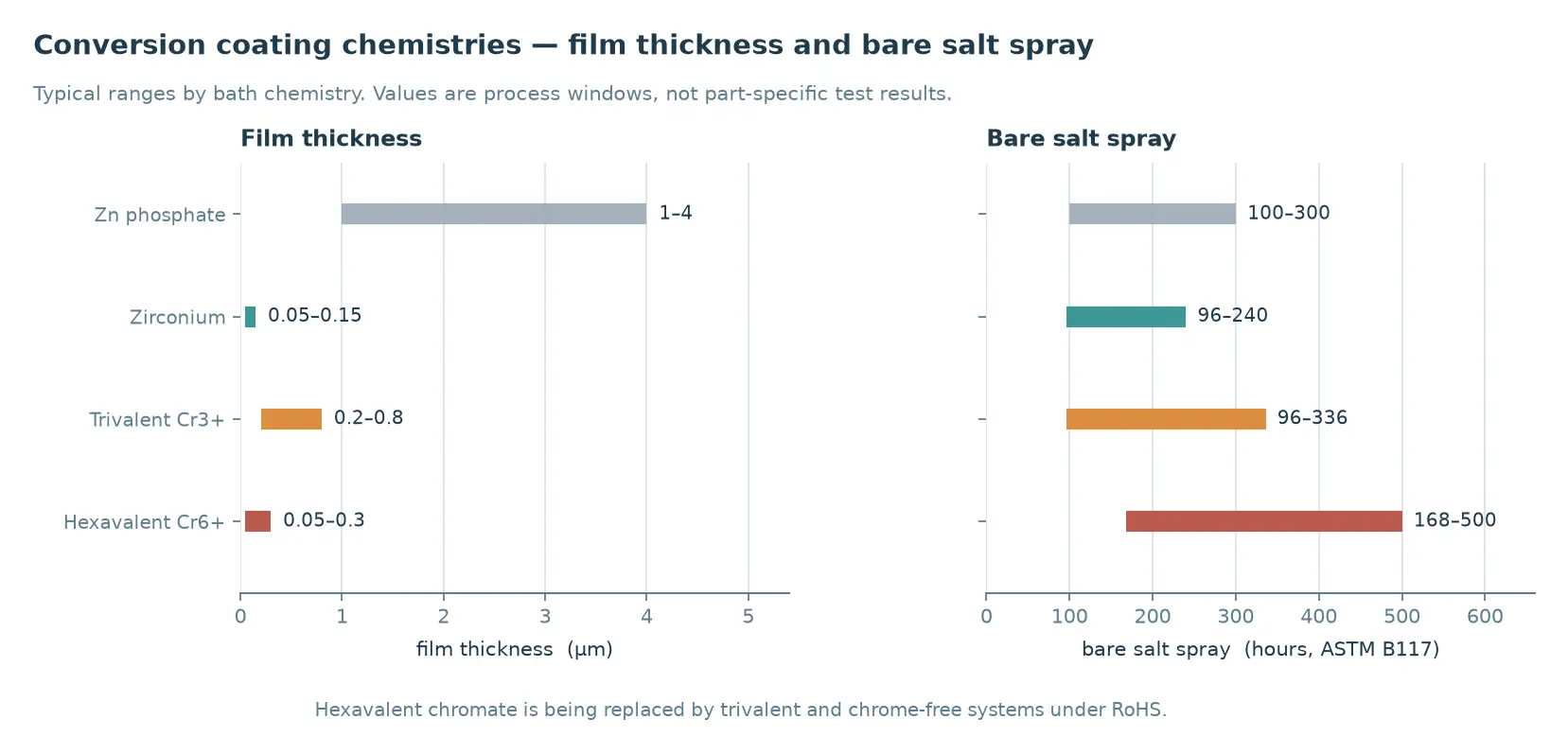
The buyer decision usually looks like this: legacy drawings keep Type I because re-qualification is expensive and the self-healing mechanism is trusted; new designs default to Type IC unless the customer’s program mandates otherwise. If you control the drawing, state which one you want explicitly. If you inherit a Type I callout and need Cr6+ compliance documentation, raise it before the RFQ, because switching chemistry is an engineering decision, not a shop-floor substitution. The same hexavalent question applies to chem film; that side of the decision is covered in our guide to MIL-DTL-81706 conversion coating materials and the MIL-DTL-5541 Class 3 conductive chem film guide.
Common Drawing Errors That Cause Rework
- Specifying “anodize per MIL-A-8625” with no type. The types are not interchangeable on thickness, fatigue or dimensional impact; state the type and class.
- Calling Type I on a 7075 part without acknowledging Type IB. Confirm the substitution path in writing before production.
- Requesting dyed Type I. The film accepts dye poorly; dyed corrosion protection is normally a Type II Class 2 job.
- Assuming Type I adds no size at all. Growth is small, roughly half the film per surface, not zero. For the tightest bores, discuss pre-plate sizing with the machining supplier.
- Using the old MIL-A-8625F letter on new documentation without checking whether your program wants the MIL-PRF-8625 designation.
How JLYPT Handles Thin-Film Anodize Work
JLYPT machines and finishes CNC aluminum in one workflow, so the anodize lot follows the machining lot without a third-party handoff that can scratch fatigue-critical surfaces in transit. Thin-film corrosion anodize is quoted with explicit handling of masking (bores, threads, contact and bonding areas), sealing choice, and witness-panel acceptance per load. Typical RFQ information we need: alloy and temper, drawing revision, type and class, sealing requirement, masked areas, and the acceptance tests your end customer expects.
RFQ Checklist for Type I and Type IB Parts
- Alloy and temper (e.g. 6061-T6, 7075-T7351, 2024-T351 with alloy mix flagged).
- Coating callout: MIL-A-8625 Type I or Type IB, Class 1 or Class 2, and the sealing requirement.
- Masking: holes, bores, threads, bonding and contact areas that must stay uncoated.
- Acceptance: 336 h salt spray on witness panels, coating weight verification, or compliance documentation required.
- Quantity and lead time, including whether test panels must accompany the shipment.
For a Type I, Type II or Type III anodize project, submit the alloy, drawing revision, quantity and coating requirements through the JLYPT quote form. State the required type and class, sealing choice, masked areas and acceptance tests so the quotation matches the drawing.
Summary
MIL-A-8625 Type I is the thin chromic anodize specified when fatigue retention and dimensional stability outrank film hardness: 0.5 to 7.6 µm of dense, chromate-bearing oxide, sealed and salt-spray tested for 336 hours. Its alloy limits and hexavalent chemistry define the boundaries, and the document answers with Type IB for 7000-series alloys and Type IC boric-sulfuric anodize for Cr6+ compliance. State the type, class and sealing explicitly on the RFQ, and the finish arrives matching both the drawing and the paperwork on the first pass.